
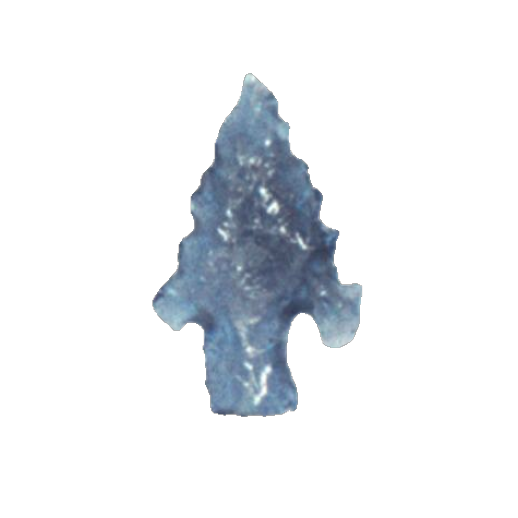
Arrowhead type
Alkali Point
AlkaliRosegate Cluster1,500 - 700 B.P.Prehistoric to Historic10 reference photos
Key facts
- Age
- 1,500 - 700 B.P.
- Cultural period
- Prehistoric to Historic
- Culture
- Shoshone Culture
- Size
- Small
- Shape
- Straight Stem to Contracting Stem
- Glacial period
- Vandal Minimum to Medieval
More from the Historic period
Description
This triangular corner notch point exhibits a slender profile, characterized by a cross-sectional shape that transitions from flat to elliptical. The blade itself is typically slender, with a curvature that can range from slightly outward (excurvate) to straight. The shoulders of the point display variability, sometimes featuring barbed tips or, alternatively, an upward inclination. A distinctive feature of this point is its long, straight stem, which occupies between one-third to one-half of the blade's overall length. The basal edge can exhibit a range of forms, from a straight line to a convex curve. The flaking pattern observed on this point is random, lacking a discernible order or arrangement.
Size
The dimensions of the arrowheads are characterized by the following measurements: overall length ranges from 18 to 41 mm, with a typical average span of 20 to 30 mm. The stem portion measures between 6 to 10 mm in length, while the blade width varies from 8 to 16 mm. Additionally, the stem width is recorded as 4 to 7 mm, and the thickness of the arrowhead is observed to be between 3 to 6 mm.
Distribution
This type is distributed across the northern Great Basin region and extends into the Columbia Plateau area
Mainly found in
Additional information
The archaeological specimen in question is a distinctive example of a Rose Springs Stemmed point, a type of projectile point that has been well-documented in the archaeological record. This particular variant is characterized by its unique combination of morphological features, which are consistent with the broader characteristics of the Rose Springs Stemmed point type.
Notably, the Rose Springs Stemmed point is a significant artifact in the study of Native American cultures, particularly in the western regions of North America. The point's design and construction reflect the technological and cultural adaptations of the indigenous peoples who created it, providing valuable insights into their daily lives, hunting practices, and social interactions.
Further examination of this variant can provide additional information about the cultural context in which it was produced, as well as the technological and stylistic developments that occurred over time. By analyzing the point's morphology, material composition, and other characteristics, researchers can gain a deeper understanding of the historical and cultural significance of the Rose Springs Stemmed point, and its importance within the broader narrative of Native American archaeology.
Identified by
- Named by
- James F. O'Connell
- Year
- 1971
Similar types
Types that are easy to confuse with the Alkali point.
- Columbia Plateau
- Hartstene Island
- Rabbit Island
- Rose Springs Stemmed
- Stockton
- Wallula Gap
Other types in the Rosegate Cluster
- Eastgate Expanding Stem
- Eastgate Split Stem
- Parowan Basal Notch
- Rose Springs Corner Notch
- Rose Springs Side Notch