
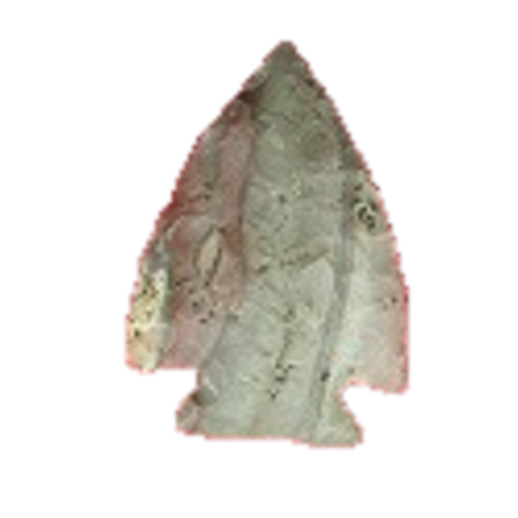
Arrowhead type
Okoboji Point
OkobojiLate Woodland Stemmed Cluster to Late Woodland Corner Notch Cluster1,900 - 1,400 B.P.Late WoodlandKey facts
- Age
- 1,900 - 1,400 B.P.
- Cultural period
- Late Woodland
- Size
- Small
- Shape
- Corner Notch
- Glacial period
- Roman Warm
More from the Woodland period
Description
This triangular corner notch point exhibits a distinctive morphology, characterized by a flattened elliptical profile. Its straight-edged blade may feature coarse serrations, adding to its functional complexity. The shoulders are sharply delineated, with pronounced barbing that accentuates their definition. The stem, which expands in width, terminates in a straight base, providing a stable platform. The flaking pattern on this point is irregular and non-directional, lacking a discernible pattern or orientation, classified as random flaking.
Size
Small
Distribution
This type is mainly discovered throughout northern Iowa, extending into southern Minnesota and southwestern Wisconsin
Also found, less often, in
Additional information
In a notable example of regional variation, the arrowhead in question exhibits a broader blade than its counterparts, distinguishing it from the Scallorn point type commonly found in more southerly locations. This distinctive characteristic sets it apart from the Scallorn type, which is typically characterized by a narrower blade. The discovery of this point type at the Gottschall Rockshelter site in Iowa County, Wisconsin, as documented by Naumann in 2008, provides valuable insight into the cultural and geographical nuances of prehistoric tool manufacture in the region. The presence of this broader-bladed point at the Gottschall Rockshelter site highlights the diversity of arrowhead styles and the importance of considering local adaptations and variations in the analysis of Native American lithic technology.
Identified by
- Named by
- Toby Morrows
- Year
- 1984
Similar types
Types that are easy to confuse with the Okoboji point.