
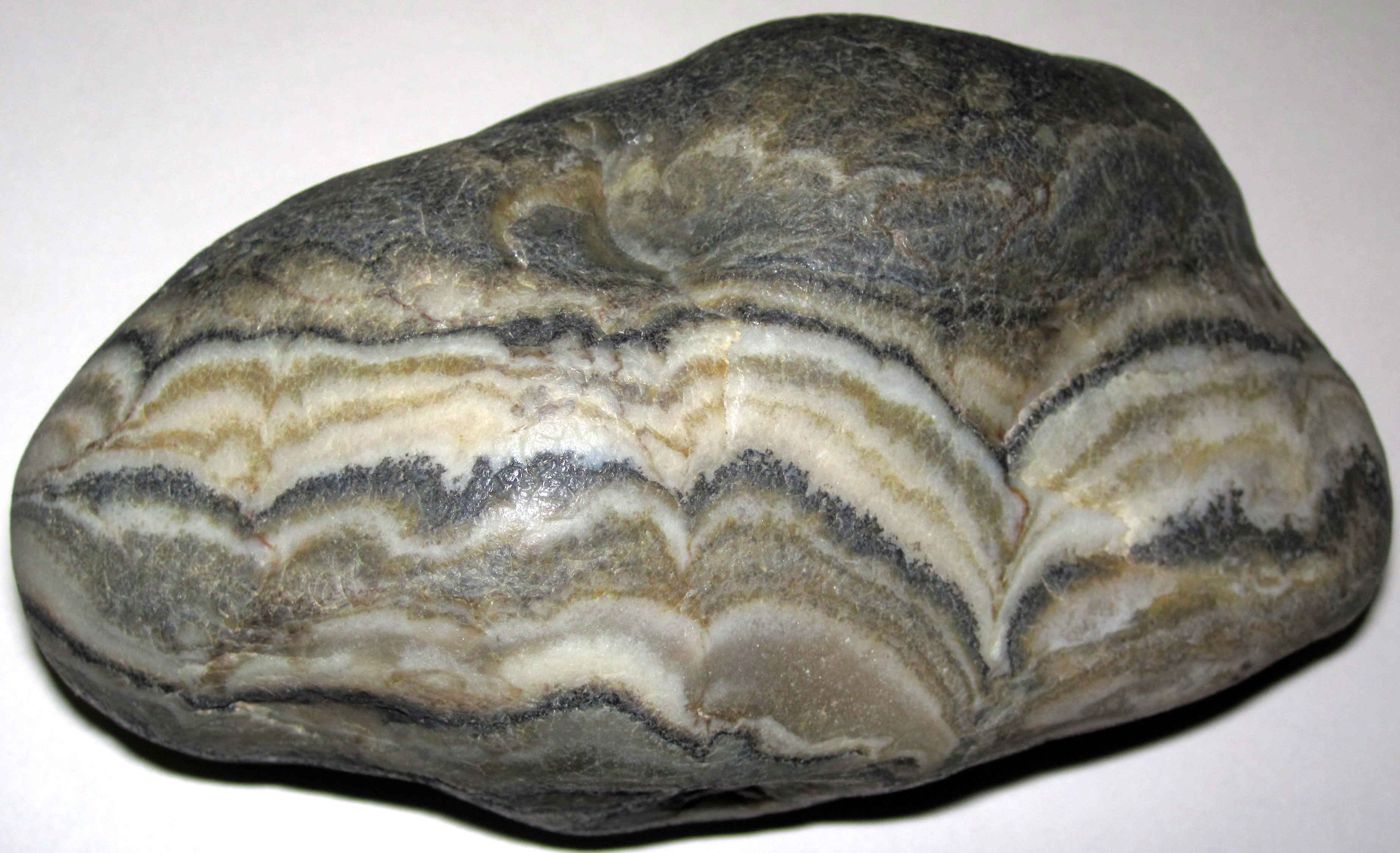
Named stone
White River Group silicates
Also called WRGS, Flattop Butte chalcedony, Flattop chalcedony, Table Mountain silicates, White River Badlands silicates
A kind of chalcedony
White River Group silicatesChalcedonyPlains2 photos
Description
White River Group silicates are high-quality cryptocrystalline stones from the Oligocene White River Group of the central Great Plains. Archaeologists group them as WRGS. Three source areas are known: Flattop Butte in northeastern Colorado, Table Mountain in east-central Wyoming, and the White River Badlands of South Dakota. Stone from these places is often visually indistinguishable, so artifacts from distant sites usually need chemical testing to name a source. Flattop Butte was worked continuously for more than 13,000 years, from the first people in the region onward, and a recent Colorado State University thesis calls its chalcedony an essential destination for ancient groups. Sentinel Butte in North Dakota, a source of 'Miocene flint', is a related locality.
Geology
Cryptocrystalline silicate (chalcedony and chert) from the Oligocene-age White River Group of the central Great Plains, with three known source areas (Flattop Butte, CO; Table Mountain, WY; White River Badlands, SD). Neutron activation analysis separates the three sources even when they look alike.
Where it comes from
Plains, Rockies & Great Basin
Quarries and outcrops
- Flattop Butte (site 5LO34), Logan County, northeastern Colorado
- Table Mountain, east-central Wyoming
- White River Badlands, South Dakota
- Sentinel Butte, Golden Valley County, North Dakota (called Miocene flint or Sentinel Butte flint in the North Dakota study unit; a 2011 paper cited by the State Survey treats it as White River Group chert)
Used by
- Flattop Butte: Paleoindian through Late Prehistoric use, over 13,000 years (Madden 2024)
- Sites in the central Plains: two sites tested by neutron activation in Hoard and others 1993
Look-alikes
Stones that are easy to confuse with White River Group silicates.
- Sentinel Butte (Miocene) flint of North Dakota: white to brownish gray, homogeneous, dull luster per the North Dakota study unit
- Knife River flint (the ND study unit calls Miocene flint much clearer than KRF)
Sources
- Hoard, Robert J., John R. Bozell, Steven R. Holen, Michael D. Glascock, Hector Neff, and J. Michael Elam. 1993. Source Determination of White River Group Silicates from Two Archaeological Sites in the Great Plains. American Antiquity 58(4):698-710.cambridge.org (opens in a new tab)
- Madden, Robert J. 2024. Chronology, spatial organization, and mobility at Flattop Butte (5LO34), a prehistoric lithic quarry in the Central Plains of North America. M.A. thesis, Colorado State University.mountainscholar.org (opens in a new tab)
- Gregg, Michael L., and Allen Bleier. 2021. The Little Missouri River Study Unit. In Historic Preservation in North Dakota (statewide plan). State Historical Society of North Dakota.history.nd.gov (opens in a new tab)
Points made from this stone
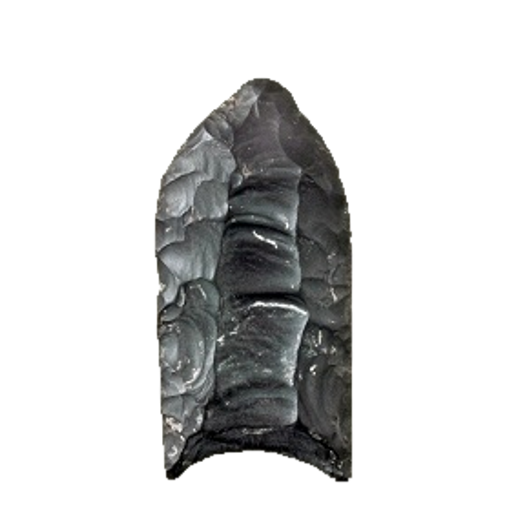 Clovis FlutedEarly Paleoindian13,050–12,750 cal B.P. (Waters et al. 2020)
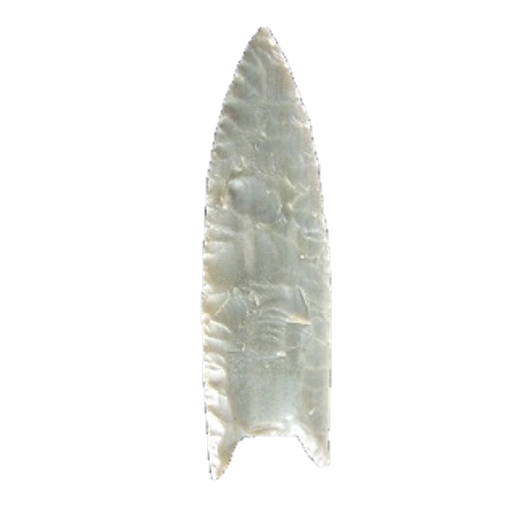 Folsom FlutedPaleoindian10,900–10,200 B.P. (Peck 2011); 11,000–10,500 B.P. in Saskatchewan (Saskatchewan Archaeological Society)
- Folsom PreformPaleoindian10,800–10,200 B.P. (radiocarbon years; about 12,900–11,900 calendar years ago) for Folsom in the Big Bend region (Seebach)
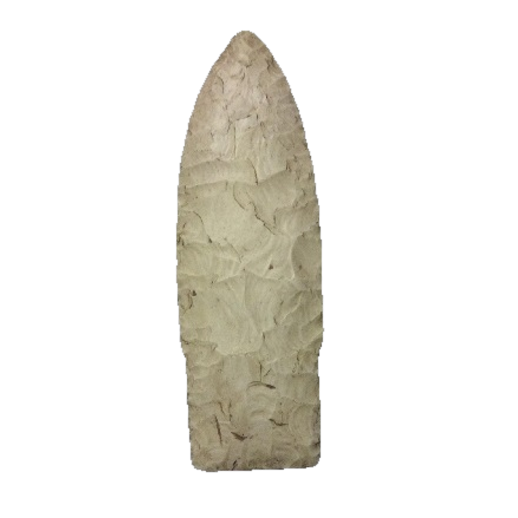 ScottsbluffLate Paleoindian9,900–8,000 B.P. (Cody complex; Knell and Muniz 2013)