Rock type
Chalcedony
Also called Chalcedonic quartz, Blue chalcedony
Chalcedonychalcedony (fibrous microcrystalline quartz)All regionsDescription
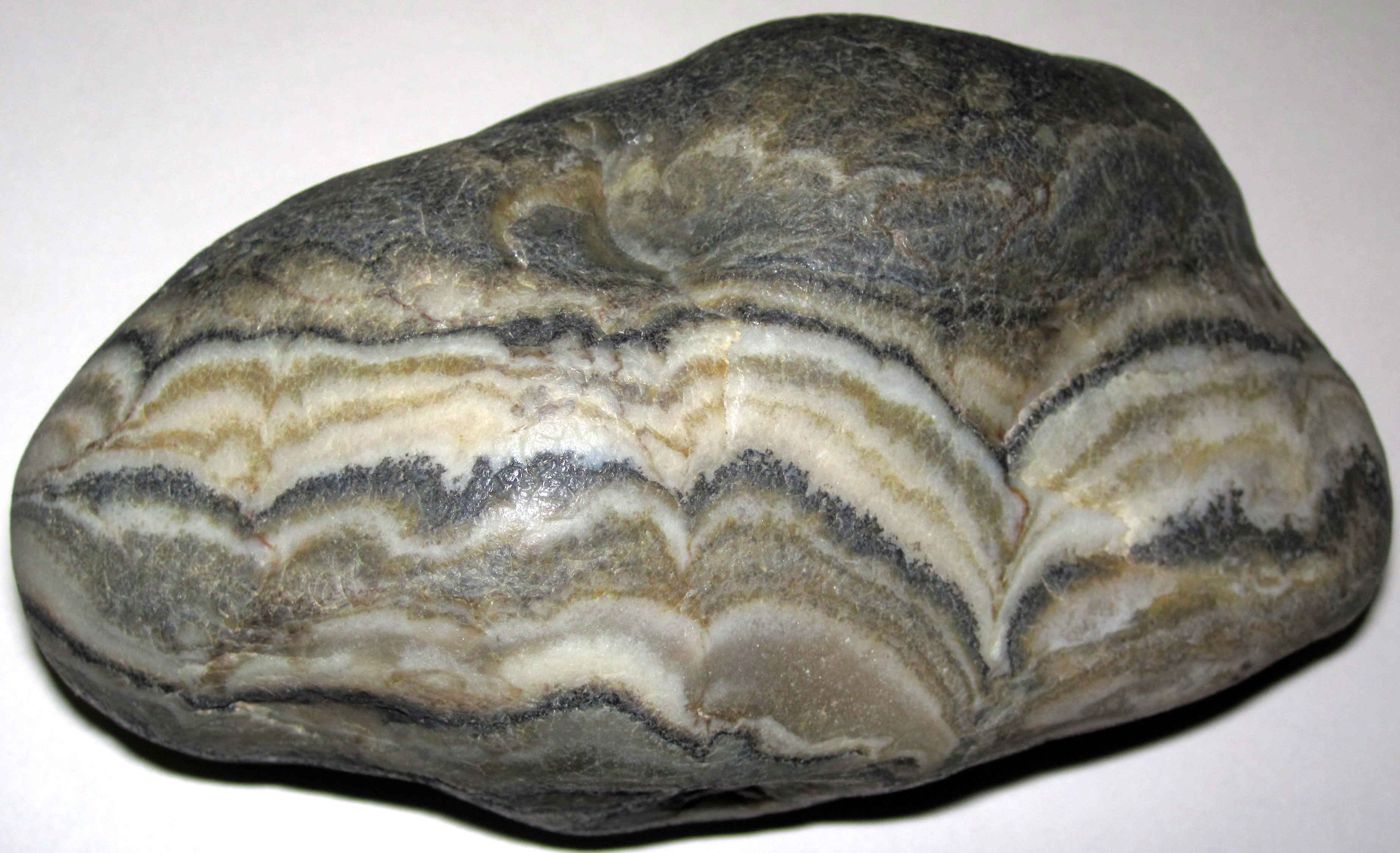
Chalcedony is a form of quartz made of microscopic fibres, waxy in luster and translucent. White to gray and grayish-blue are the commonest colours, with brown, gold, nearly black and colourless pieces also seen. Agate, carnelian, onyx and bloodstone are named varieties, and the USGS counts flint, chert, jasper and petrified wood as relatives. In the East it appears as the translucent blue bands of Flint Ridge flint, as nodules up to 10 inches across in Washington County, Virginia, and as the cement in Hixton sandstone and Tallahatta quartzite. The USGS notes that early peoples made points, knives and tools from chalcedony varieties, but it is usually uncommon on Maryland sites and a minor stone beside chert.
How to identify it
- Colour
- White to gray, grayish-blue or nearly black are the most common (Maryland guide); blue or grayish blue at Flint Ridge (Getz); pale brown, gold or colourless in Minnesota drift (Bakken).
- Texture
- Dense and fibrous; microscopic crystals arranged in slender fibres in parallel bands.
- Luster
- Waxy.
- Cortex
- Rounded Virginia nodules have a fractured outer shell with transparent zones inside (DHR).
Geology
Chalcedony is microcrystalline quartz with a fibrous structure. It forms in all kinds of rock, sedimentary, igneous and metamorphic, and the USGS says some variety is found in all 50 states. Virginia's state guide describes rounded chalcedony nodules up to 10 inches across that weather out of the Ordovician Conococheague Limestone and collect in terrace gravels near South Holston Lake. In Mississippi, Tallahatta agate is an opal-rich chalcedony that fills joints and burrows with the quartzite. The USGS lists agate, flint, chert, jasper and petrified wood among the chalcedony varieties.
Where it comes from
All regions
States
Quarries and outcrops
- Washington County, Virginia (South Holston Lake terrace gravels)
- Flint Ridge, Licking and Muskingum counties, Ohio (blue chalcedony)
- Tallahatta Formation, Mississippi (Tallahatta agate)
- All 50 states produce some chalcedony (USGS)
Used by
- Early peoples made weapons and tools from chalcedony varieties, according to the USGS
- Southwest Virginia artifacts of all periods made from the South Holston Lake nodules (DHR)
Look-alikes
Stones that are easy to confuse with Chalcedony.
- Chert (generally opaque, not fibrous)
- Agate (banded chalcedony) and jasper (opaque, iron-rich)
- Opal-cemented quartzites
Sources
- Maryland Archaeological Conservation Laboratory. Chalcedony. Diagnostic Artifacts in Maryland: Common Stone Types (Jefferson Patterson Park and Museum).apps.jefpat.maryland.gov (opens in a new tab)
- Delaware Department of Transportation. Archaeology glossary.deldot.gov (opens in a new tab)
- U.S. Geological Survey. 1995. Gemstones: Chalcedony (SP-14-95), Mineral Information archive.apps.usgs.gov (opens in a new tab)
- Getz, Garry L. 2016 (rev.). Flint: Ohio's Official Gemstone. Educational Leaflet No. 6. Ohio Department of Natural Resources, Division of Geological Survey.dam.assets.ohio.gov (opens in a new tab)
- McIlhany. 2000. Chalcedony. Virginia Department of Historic Resources, Lithics (Projectile Points and Lithics guide).dhr.virginia.gov (opens in a new tab)
- Bakken, Kent E. (written about 1995; PDF issued later). Chipped Stone Raw Materials. Chapter 6 in Stone Tools of Minnesota. Minnesota Office of the State Archaeologist, St. Paul.mn.gov (opens in a new tab)