

Rock type
Jasper
Also called Red jasper, Yellow jasper, Pebble jasper
Jasperjasper (iron-rich chert)All regionsDescription
Jasper is chert coloured by iron: opaque, often waxy, and typically red, yellow, orange or brown, sometimes green. Its iron comes from different settings. Pelletal jasper replaced iron-rich limy mud on shallow tropical sea floors; Hardyston jasper of Pennsylvania formed when hot water replaced quartzite; banded iron formation jasper is laminated, brick red and softer than most. Heating generally makes jasper waxier and redder. Burial in tidal marsh can change surface colours so that jasper looks like plain chert, and jasper of one colour can come from many places, so a colour name alone says little about the source. Named sources include Hardyston (Pennsylvania) and Flint Run (Virginia).
How to identify it
- Colour
- Red, yellow, orange or brown from iron impurities; some jasper is green (reduced iron) or brick red (oxidised iron).
- Texture
- Fine grained, often waxy; banded iron formation jasper is finely laminated and may be crossed by quartz veins.
- Luster
- Often lustrous and waxy; banded iron formation jasper has a matte luster on fresh breaks but polishes.
- Inclusions
- Quartz veins or chalcedony coatings in some pieces.
- Heat treatment
- Heating generally makes jasper waxier and redder (Maryland guide).
Geology
Jasper is a colourful chert whose colour comes from iron. In the Gulf Coastal Plain gravels, pelletal jaspers derive from Paleozoic bedrock rocks that were iron-rich carbonate muds; red jasper has iron in an oxidised state and green jasper in a reduced state, and banded iron formation jasper comes from far north in the Mississippi watershed. Pennsylvania jasper is hydrothermal replacement of quartzite in the Hardyston Formation. Flint Run jasper formed where weathered silica-rich volcanic rock released iron oxide and silica that groundwater deposited in carbonates. Minnesota's jasper taconite is deep red with small round inclusions that look like ooliths.
Where it comes from
All regions
Quarries and outcrops
- Hardyston Formation, Pennsylvania
- Flint Run, Warren County, Virginia
- Point of Rocks, Frederick County, Maryland, and Iron Hill, Delaware (named by the Maryland guide)
- Pre-loess terrace and Mississippi River gravels, Mississippi
- Jasper taconite, northeastern Minnesota and Ontario
Used by
- Jasper was valued in the Middle and Late Archaic lower Mississippi Valley lapidary industry for its colour (MDEQ)
Look-alikes
Stones that are easy to confuse with Jasper.
- Plain chert, especially after burial in tidal marsh (Maryland guide)
Sources
- Maryland Archaeological Conservation Laboratory. Jasper. Diagnostic Artifacts in Maryland: Common Stone Types (Jefferson Patterson Park and Museum).apps.jefpat.maryland.gov (opens in a new tab)
- Delaware Department of Transportation. Archaeology glossary.deldot.gov (opens in a new tab)
- Mississippi Department of Environmental Quality, Office of Geology. Lithic Materials (web page; updated December 2023).mdeq.ms.gov (opens in a new tab)
- Bakken, Kent E. (written about 1995; PDF issued later). Chipped Stone Raw Materials. Chapter 6 in Stone Tools of Minnesota. Minnesota Office of the State Archaeologist, St. Paul.mn.gov (opens in a new tab)
- Ebright, Carol. 1999 (updated 2023). Pennsylvania Jasper. Virginia Department of Historic Resources.dhr.virginia.gov (opens in a new tab)
- Walker. 1999. Flint Run Jasper. Virginia Department of Historic Resources, Lithics (Projectile Points and Lithics guide).dhr.virginia.gov (opens in a new tab)
Named stones of this kind
- Brook Run jasperjasper (brecciated, hydrothermal)Virginia
- Flint Run jasperjasper (iron-rich chert)Virginia
- Hardyston jasperjasper (iron-rich chert replacing quartzite)Pennsylvania, New Jersey
- Iron Hill jasperjasper (ferruginous chert from weathered gabbro)Delaware, Maryland
- Jasper taconiteiron-formation jasper (Precambrian)Minnesota
- Tecovas jasperchert (often called jasper) from the Tecovas FormationTexas, New Mexico, Oklahoma
- Trout Creek jasperjasper (iron-rich chert)Colorado
Points made from this stone
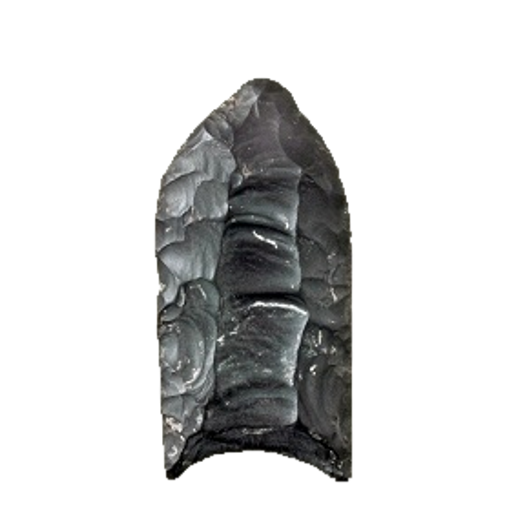 Clovis FlutedEarly Paleoindian13,050–12,750 cal B.P. (Waters et al. 2020)
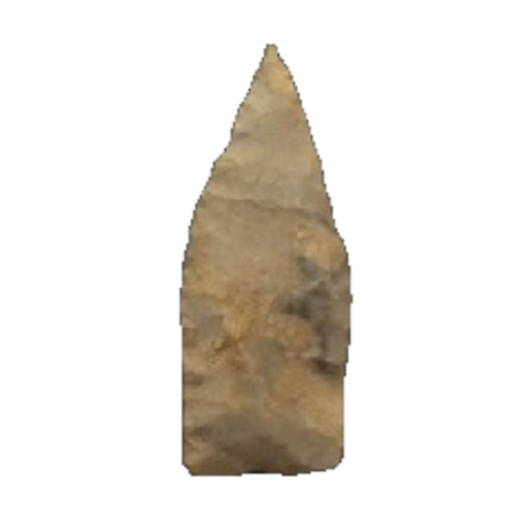 Jacks Reef PentagonalMiddle Woodland to Late WoodlandAbout 1,640–1,000 B.P. (A.D. 310–955; radiocarbon dates compiled by the Maryland Archeology guide); mainly A.D. 700–1300 in Virginia (Virginia DHR); 1057 ± 250 B.P. at the White Site, New York (Ritchie 1961, via Cambron and Hulse 1975)
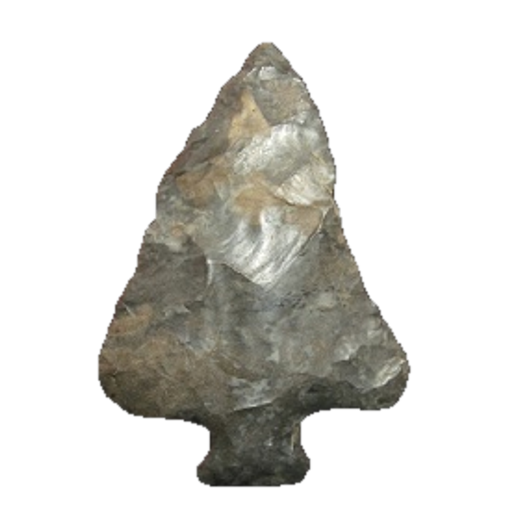 PerkiomenTerminal ArchaicAbout 3,670–3,450 B.P. (1720–1500 B.C., radiocarbon, upper Delaware Valley; Maryland JPPM); 3,450–3,150 B.P. (1500–1200 B.C.; Virginia DHR)