Named stone
Tecovas jasper
Also called Tecovas chert, Tecovas chert and quartzite (Texas Beyond History exhibit name)
A kind of jasper
Tecovas jasperJasperTexas & SouthwestDescription
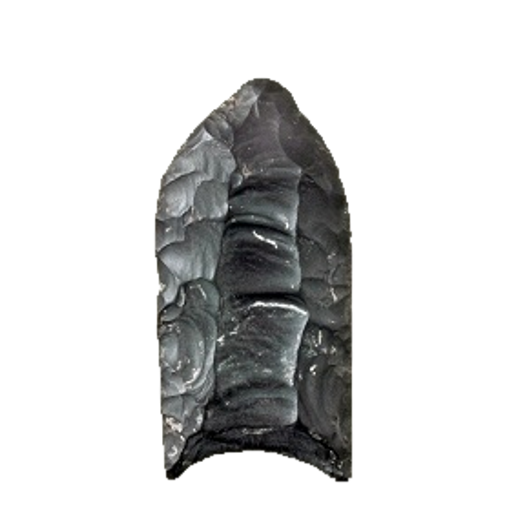
Tecovas jasper is the second big toolstone of the Texas Panhandle, after Alibates. It comes from the Tecovas Formation, a Late Triassic unit of mostly colorful shales. The stone is fine-grained like Alibates but is opaque, often with tiny bluish-white quartz-filled vugs, and is usually variegated or mottled. Colours include red, brown, cream, white, yellow, green and maroon. The best-known source is the Quitaque area of Briscoe County, but outcrops and quarries are also recorded in Potter, Oldham and Moore counties and in Palo Duro Canyon. Tecovas has been visually identified in Clovis and Folsom sites such as Blackwater Draw, and was likely used through prehistory. It is often confused with Alibates, so geochemical testing is used to separate the two.
How to identify it
- Colour
- White through yellow, red, maroon and brown, mottled; most pieces are red, brown, cream, white, yellow or green. Red Tecovas is a more even red than Alibates.
- Texture
- Fine-grained, like Alibates, and opaque; found as massive boulders up to about a meter across, with tiny quartz-filled vugs.
- Inclusions
- Bluish-white quartz vugs; mottling or variegation is the usual way to tell it from Alibates.
- Fluorescence
- Both Alibates and Tecovas give a very dark or purple, velvet-like response under ultraviolet light, so UV does not separate them (Hofman and others 1991, as cited by the BLM report).
Geology
Chert or jasper beds in the Late Triassic Tecovas Formation (Dockum Group), a unit averaging about 61 m thick in Potter County and made of variously coloured shales and soft micaceous sandstone. The best-known source is near Quitaque, about 112 km southeast of Amarillo. Lateral equivalents in northeast New Mexico, such as the Baldy Hill Formation, produce a jasper that closely resembles some Alibates (called 'False Alibates').
Where it comes from
Texas & Southwest, Plains
States
Quarries and outcrops
- Quitaque area, Briscoe County, Texas (best-known source)
- South Basin quarries (41OL284), Oldham County
- Blue Creek area, Moore County, north of Lake Meredith
- Coetas Creek (41PT434) and West Amarillo Creek (41PT276), Potter County
- Palo Duro Canyon (M-122)
Used by
- Clovis and Folsom (visually identified in sites such as Blackwater Draw No. 1)
- Probably all periods of prehistory in the Panhandle
- Late Prehistoric caches in the region (Turkey Creek and a Motley County cache of bifaces and flakes)
Look-alikes
Stones that are easy to confuse with Tecovas jasper.
- Alibates agatized dolomite (more banded; can look very similar)
- Baldy Hill jasper of northeast New Mexico ('False Alibates')
Sources
- Quigg, J. Michael, Charles D. Frederick, Paul M. Matchen, and Kendra G. DuBois. 2010. Landis Property: Data Recovery at Three Prehistoric Sites (41PT185, 41PT186, and 41PT245) in Potter County, Texas, Volume I. TRC Report 150832, for the Bureau of Land Management Amarillo Field Office.texasbeyondhistory.net (opens in a new tab)
- Texas Beyond History (University of Texas at Austin, Texas Archeological Research Laboratory). Stone Tools of Texas: Tecovas chert and quartzite.texasbeyondhistory.net (opens in a new tab)