Named stone
Florence chert
Also called Florence A chert, Florence flint, Flint Hills chert (in part)
A kind of chert (and flint)
Florence chertChert (and flint)PlainsDescription
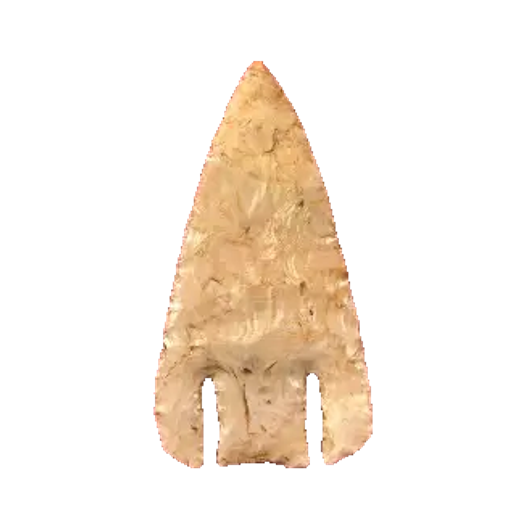
Florence chert comes from the Florence Flint of the Permian Chase Group, which runs through the Flint Hills of Kansas into Oklahoma. It occurs as tabular and rounded nodules, 1 to 5 inches thick, in layers between limestone beds. Broken faces are steel-gray and blue, while weathered surfaces turn tan and then rusty brown. Unlike the nearby Foraker chert, it is generally free of the little fusulinid fossils. Oklahoma archaeologists prize the best grade, called Florence A, and mapped big prehistoric quarries for it in northern Kay County. It was used across the Southern Plains from about 5,000 to 300 years ago. Flint Hills quarry sites in Kansas run from Cowley County north to Pottawatomie County. Heat treatment improved Kansas cherts, and Calf Creek knappers heat-treated Florence A preforms.
How to identify it
- Colour
- Steel-gray and blue on fresh breaks; tan, then dark tan and rusty brown as it weathers (Kansas Geological Survey). Flint Hills cherts in general are buff to blue-gray (Kansas Historical Society).
- Texture
- Distinctly nodular; nodules 1 to 5 inches thick, in some layers joined into continuous sheets.
- Inclusions
- Generally unfossiliferous. It lacks the Fusulina fossils common in the Foraker chert.
- Heat treatment
- Heat treatment improves the tough, modest-quality Flint Hills cherts and was known in Kansas from Paleoindian times (Kansas Historical Society). Calf Creek knappers heat-treated Florence A preforms (Missouri Archaeological Society).
Geology
Florence Flint of the Permian Chase Group: thick-bedded, fossil-rich limestone interbedded with chert, 11 feet thick at the Kansas-Oklahoma line and up to about 35 feet to the north. It is the highest chert-rich unit in the Kansas Permian section. Named by Prosser for quarries near Florence, Marion County, Kansas. It forms upland surfaces strewn with weathered chert fragments averaging about 2 inches across.
Where it comes from
Plains
Quarries and outcrops
- Florence, Marion County, Kansas (type quarries)
- Cowley and Butler counties, Kansas (upland chert surfaces)
- Northern Kay County, Oklahoma (large prehistoric quarries for Florence A chert)
- Flint Hills quarry sites from Cowley County to Pottawatomie County, Kansas
Used by
- Calf Creek (heat-treated Florence A preforms)
- Oklahoma: use about 5,000 to 300 years ago across the Southern Plains (Oklahoma SHPO)
- Kubik site, Kay County: Calf Creek camp near the quarries
Look-alikes
Stones that are easy to confuse with Florence chert.
- Foraker chert (contains abundant Fusulina fossils)
- Wreford chert (the Kansas Survey says Florence nodules are in general smaller, but not reliably so; Wreford sits in distinctive pitted white limestone)
- Threemile and Schroyer cherts (other Flint Hills cherts widely used in Kansas)
- Burlington and Keokuk cherts (also heat-treated by Calf Creek knappers)
Sources
- Kansas Geological Survey. 1929. Geology of Cowley County, Kansas (Bulletin 12): Stratigraphy, Permian System.kgs.ku.edu (opens in a new tab)
- Oklahoma State Historic Preservation Office. 2015. Tomorrow's Legacy: Oklahoma's Statewide Preservation Plan (January 2015 - December 2019). Oklahoma Historical Society.okhistory.org (opens in a new tab)
- Reynolds, John D., and William B. Lees. 2004. The Archeological Heritage of Kansas. Kansas Historical Society.kansashistory.gov (opens in a new tab)
- Ray, Jack H., and Neal H. Lopinot. To the Point: Calf Creek. Missouri Archaeological Society.missouriarchaeologicalsociety.org (opens in a new tab)