Named stone
Dover chert
Also called Dover flint, Lower St. Louis chert, variety Dover (the geological name Parish argues for)
A kind of chert (and flint)
Dover chertChert (and flint)Southeast2 photos
Description
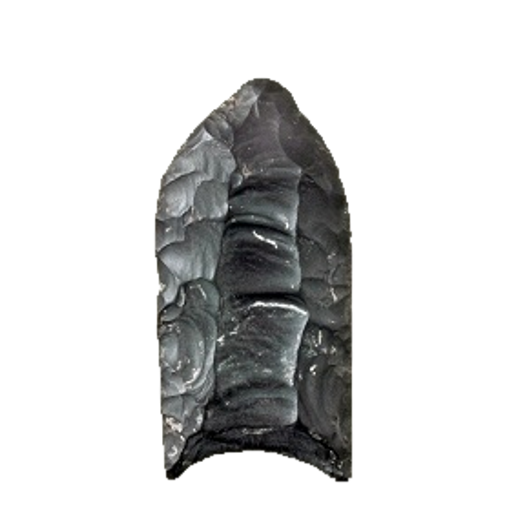
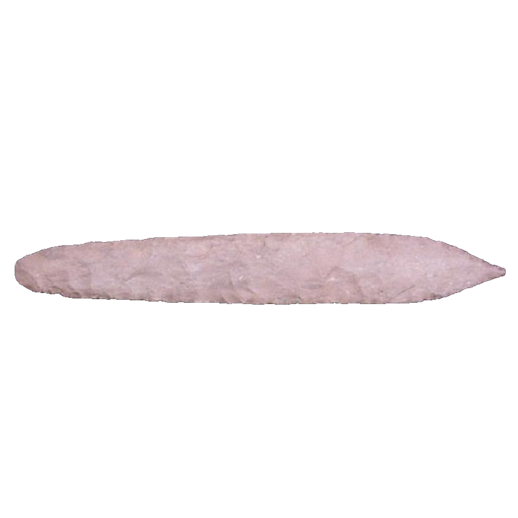
Dover chert comes from quarries on the Cumberland River in Stewart County, Tennessee, where Mississippian miners cut large slabs of it for big bifaces: hoes, axes, adzes, long knives and ceremonial 'swords' and effigy shapes. It is a brownish, mottled chert; one description is brownish with slight blue specks. The finished tools travelled widely through the Tennessee and Cumberland valleys and up the Ohio River. Visual identification is unreliable: Fort Payne chert from the same region looks very similar, and reflectance-spectroscopy tests found that many artifacts called Dover, including some famous swords, are really Fort Payne. It is far better known for large bifaces than for arrow or dart points.
How to identify it
- Colour
- Brown and mottled (Parish and Butler 2015); described as brownish with slight blue specks (Tennessee Encyclopedia). Museum specimens on Commons look gray with paler streaks, so freshness and weathering change the look.
- Texture
- Described as having a 'peculiar grain' by the Tennessee Encyclopedia, with no technical grain description found.
Geology
Marcher (1962) assigned the chert to the lower part of the Mississippian St. Louis Limestone, and Parish argued that assignment is right ('Lower St. Louis, variety Dover'). Other writers tied it to the Fort Payne Formation, which is one reason the two are mixed up. Quarry work shows the chert is unevenly distributed across the landscape.
Where it comes from
Southeast
States
Quarries and outcrops
- Dover Flint Quarries, Stewart County, Tennessee, on the Cumberland River (National Register of Historic Places, 1973)
- Dover quarry site complex
- Imported to the Black Bottom of southern Illinois (Kincaid site), about 100 km up the Cumberland River
Used by
- Mississippian: large bifaces, hoes, ceremonial blades
- Parish and Butler report 'Dover-like' chert at Kincaid from the late Middle Archaic on, but testing suggests those pieces are mostly local Fort Payne
Look-alikes
Stones that are easy to confuse with Dover chert.
- Fort Payne chert (the main confusion: visual sorting of the two is unreliable)
- Mill Creek chert of southern Illinois (its hoes competed with Dover bifaces)
Sources
- Parish, Ryan M., and Brian M. Butler. 2015. The Use of Dover-Like Tool Stone by Pre-Mississippian Peoples in the Black Bottom of Southern Illinois. Illinois Archaeology 27:118-137.par.nsf.gov (opens in a new tab)
- Parish, Ryan M. 2013. Relationships between Procurement Strategies and Geologic Provenience at the Dover Quarry Site Complex, Tennessee. North American Archaeologist 34(4):369-385.doi.org (opens in a new tab)
- West, Carroll Van. 2017 (updated 2018). Dover Flint Quarries. Tennessee Encyclopedia, Tennessee Historical Society.tennesseeencyclopedia.net (opens in a new tab)