
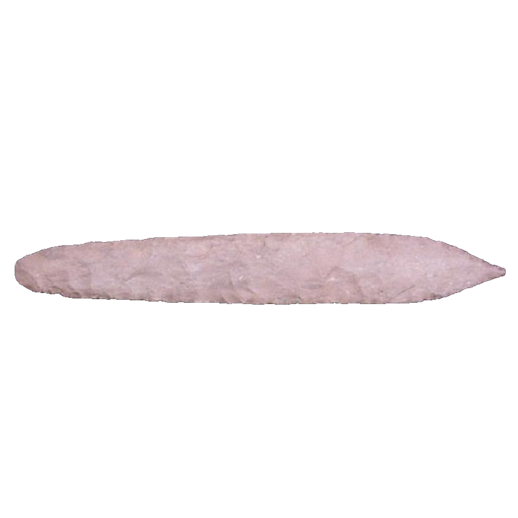
Arrowhead type
Duck River Ceremonial Blade
Duck River Ceremonial Blade1,100 - 600 B.P.MississippianKey facts
- Age
- 1,100 - 600 B.P.
- Cultural period
- Mississippian
- Size
- Large
- Shape
- Ovoid to Lanceolate
- Material
- Shell
- Glacial period
- Medieval Warm
More from the Mississippian period
Description
This substantial ovoid blade exhibits a pronounced elliptical profile, characterized by a slender, excurvate form with parallel edges that converge towards the base, culminating in a typically acuminate tip. The base of the blade is marked by a convex curvature. The flaking pattern on this specimen is predominantly random, arising from a near-collateral flaking technique that lacks a median ridge, complemented by meticulous fine pressure flaking along the edges. The overall craftsmanship of this blade is of exceptional quality, underscoring the skill of its manufacturer.
Size
The dimensions of the arrowheads are characterized by a total length ranging from 200 to 350 mm and a width spanning 30 to 40 mm, as determined from a limited dataset.
Distribution
This type is mainly frequently linked to ritual sites and ancient graves. Discoveries have been documented from the Duck River in western Tennessee to Etowah in northern Georgia and the Spiro Mound in eastern Oklahoma
Mainly found in
Also found, less often, in
Additional information
The Duck River blade, a distinctive type of ceremonial artifact, derives its name from the notable Duck River cache, which yielded an impressive assemblage of 46 artifacts, including large, sword-like blades. Characteristically, these blades are discovered in contexts associated with ceremonial or burial activities, underscoring their significance in the spiritual and cultural practices of the indigenous populations. Notably, the largest example of such a blade was unearthed at the Etowah site in northern Georgia, highlighting the importance of this region in the production and use of these artifacts.
The Duck River blades are particularly intriguing due to their association with ceremonial dances, specifically those performed by winged eagle dancers. These dances, an integral part of the cultural and religious heritage of Native American communities, involved the use of these blades as symbolic or ritualistic objects. The depiction of feathered dancers on a shell gorget found at the Hixton site in Hamilton County, Tennessee, provides valuable insight into the context in which these blades were used. As described by Madeline Kneberg, the dancers are often illustrated holding a "Duck River type artifact" in one hand and a crescent-shaped object in the other, further emphasizing the ceremonial significance of these blades.
The study of Duck River blades offers a unique window into the cultural and spiritual practices of Native American communities, particularly in the southeastern United States. Through the analysis of these artifacts and their contexts, researchers can gain a deeper understanding of the symbolic and ritualistic significance of these objects, as well as the importance of ceremonial dances in the cultural heritage of these communities. The discovery of these blades in ceremonial and burial contexts serves as a testament to their enduring significance, highlighting the need for continued research and preservation of these important cultural artifacts.
Identified by
- Named by
- James A. Brown
- Year
- 1976
- Type site
- Duck River Cache, Humphreys County, Tennessee
Similar types
Types that are easy to confuse with the Duck River Ceremonial Blade point.
- Adena Blade
- Benton Blade
- Cotaco Blade
- Morse Knife
- Snake Creek Blade
- Tennessee River
Other types in this cluster
- Dagger Knife
- Duck River Blade
- Ramey Knife
- Ross Blade