Named stone
Cobden and Dongola cherts
Also called Cobden-Dongola chert, Upper St. Louis chert
A kind of chert (and flint)
Cobden and Dongola chertsChert (and flint)Midwest/Ohio ValleyDescription
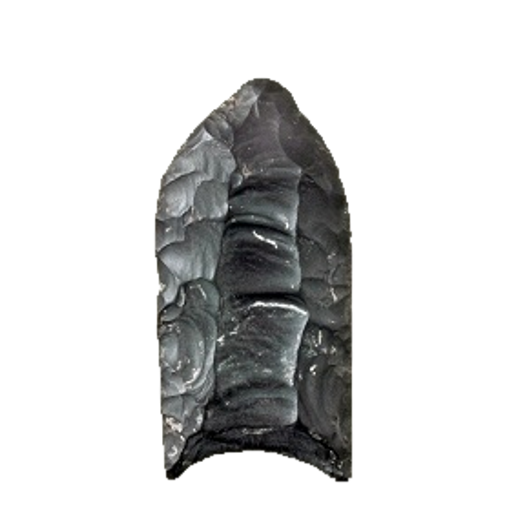
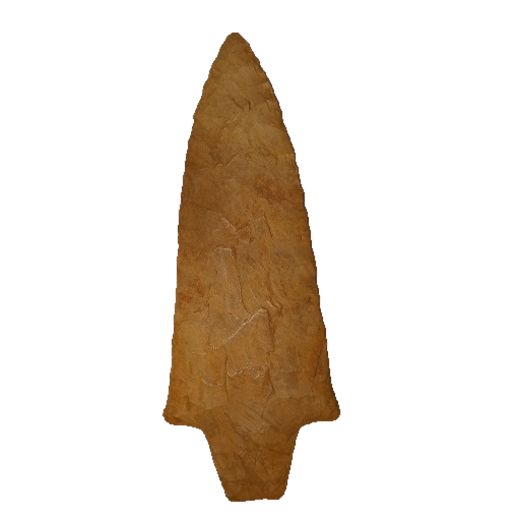
Cobden and Dongola cherts are nodular cherts from the Mississippian Upper St. Louis Limestone of southern Illinois, usually treated as one source called Cobden-Dongola. Illinois State Archaeological Survey researchers group them with Wyandotte chert and Kentucky Blue chert as the blue-gray cherts of the Midwest, valued by Paleoindian, Late Archaic and Middle Woodland peoples and moved across great distances. Their colours are so alike that standard colour measurement could not separate the sources, though barium looks promising as a Cobden-Dongola marker. The St. Louis Limestone is a fine-grained, cherty limestone with many sinkholes where it crops out. People living at Kincaid in the Black Bottom could reach these cherts within about 100 km.
How to identify it
- Colour
- Blue-gray (Butler and others); colour ranges overlap with Wyandotte and Kentucky Blue chert.
- Texture
- Nodular.
Geology
Nodular chert from the Upper St. Louis Limestone. The St. Louis Limestone in Illinois is fine-grained, micritic to lithographic, cherty limestone with beds of dolomite, crystalline and fossiliferous limestone and evaporites, and its outcrops have abundant sinkholes. Parish and Butler list Upper St. Louis (Cobden, Dongola) nodular chert among materials reachable from the Black Bottom, with the Shawnee Hills to the west.
Where it comes from
Midwest/Ohio Valley
States
Quarries and outcrops
- Shawnee Hills, southern Illinois (Upper St. Louis Limestone chert source area)
Used by
- Paleoindian, part of the Late Archaic (1,500-400 B.C.) and Middle Woodland: blue-gray Midwestern cherts of this kind travelled far (Butler and others)
Look-alikes
Stones that are easy to confuse with Cobden and Dongola cherts.
- Wyandotte chert (blue-gray; colour ranges overlap)
- Kentucky Blue chert
- Fort Payne and Mill Creek chert, which occur in the same part of Illinois
Sources
- Butler, Shane K., Madeleine G. Evans, and Richard A. Cahill. 2016. Quantitative methods of chert source identification as a tool for archaeological interpretation. Abstracts with Programs, Geological Society of America 48, Paper No. 16-1. doi:10.1130/abs/2016NC-275195.experts.illinois.edu (opens in a new tab)
- Illinois State Geological Survey. St. Louis Limestone. Online Handbook of Illinois Stratigraphy (ILSTRAT; after Willman and others 1975, Illinois State Geological Survey Bulletin 95).ilstratwiki.web.illinois.edu (opens in a new tab)
- Parish, Ryan M., and Brian M. Butler. 2015. The Use of Dover-Like Tool Stone by Pre-Mississippian Peoples in the Black Bottom of Southern Illinois. Illinois Archaeology 27:118-137.par.nsf.gov (opens in a new tab)