Named stone
Bangor chert
Also called Bangor flint, Bangor blue chert, Blue-gray Bangor chert
A kind of chert (and flint)
Bangor chertChert (and flint)SoutheastDescription
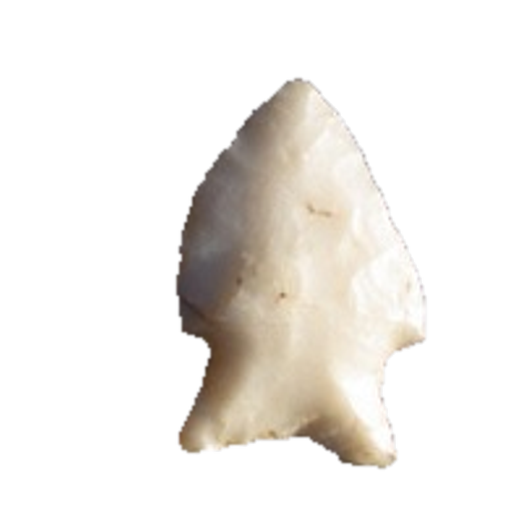
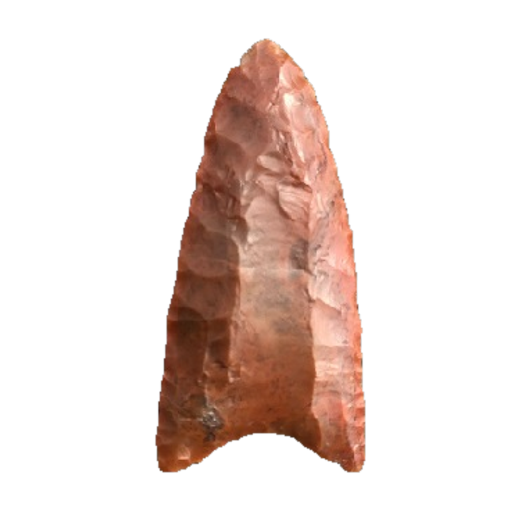
Bangor chert is the translucent blue-gray to blue-green chert of north Alabama's Tennessee Valley, from the Bangor formation. Light blues and greens with varying gray, often banded and rarely mottled, it is fine grained, glossy and flakes excellently. Pieces nearest the rind are white to tan, and a band of red often sits just inside the cortex. Translucency is the usual way to separate it from the best blue-gray Fort Payne chert, which is opaque, though that test is not foolproof. Heating was rarely needed, and when it was done the red band is uneven. Wheeler Basin archaeologists have reported that later chipped-stone tools there are usually Bangor, and a Bangor flake turned up at Poverty Point in Louisiana.
How to identify it
- Colour
- Light blues and greens with varying levels of gray; banded; white to tan near the cortex, often with a red band just inside it. A black variety is also noted.
- Texture
- Fine grained.
- Luster
- High.
- Inclusions
- Mottling is rarely present, unlike Fort Payne (Barry).
- Cortex
- The zone nearest the cortex is sometimes white to tan, with a red band next.
- Heat treatment
- Heating does not seem to have been common. When heated, the effect is uneven, leaving an inconsistent red band; the high luster and fine grain make heat treatment hard to detect (Barry).
Geology
The Bangor formation lies in north Alabama near the Tennessee River; the blue-gray or blue-green Bangor chert comes from the middle part of the Tennessee Valley in Alabama. Mississippi's survey notes that chert gravel of the Tuscaloosa Formation was derived largely from erosion of the Fort Payne, Tuscumbia and possibly Bangor limestones.
Where it comes from
Southeast
Quarries and outcrops
- Middle Tennessee Valley of north Alabama, including the Wheeler Basin
Used by
- Wheeler Basin: later chipped stone assemblages, after the Paleoindian period, are usually Bangor chert (Futato, reporting amateur archaeologists)
- Found at (not a source): Pickwick area chert reached Poverty Point, Louisiana, per Futato (a Bangor flake with cortex was found there)
Look-alikes
Stones that are easy to confuse with Bangor chert.
- Blue-gray Fort Payne chert: very similar, but Fort Payne is opaque and often mottled
- Tuscumbia chert: the blue-gray variety can be misidentified as Bangor (MDEQ)
- Black Knox chert: similar color but lacks translucency (Barry)
Sources
- Barry, Steven Edward. 2004. Lithic Raw Materials and Chipped Stone Tools: A Comparison of Two Sites in the Moundville Chiefdom. M.A. thesis, Department of Anthropology, University of Alabama, Tuscaloosa.rla.unc.edu (opens in a new tab)
- Futato, Eugene M. 1980. An Overview of Wheeler Basin Prehistory. Journal of Alabama Archaeology 26(2):110-135.alabamaarchaeology.org (opens in a new tab)
- Mississippi Department of Environmental Quality, Office of Geology. Lithic Materials (web page; updated December 2023).mdeq.ms.gov (opens in a new tab)
- U.S. Geological Survey, National Geologic Map Database. Geolex: Bangor publications.ngmdb.usgs.gov (opens in a new tab)