
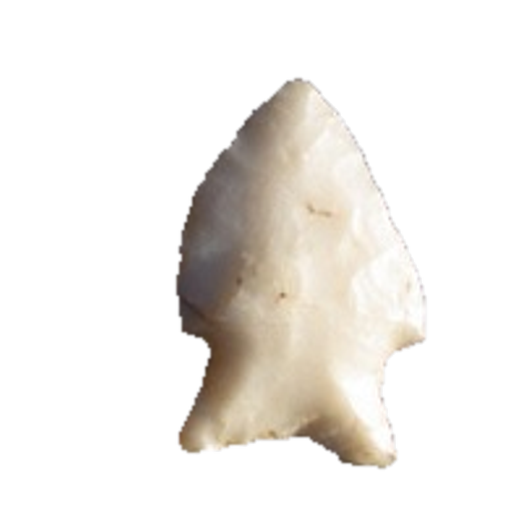
Arrowhead type
Cave Spring Point
Cave Spring9,500 - 9,000 B.P.Transitional Paleo to Early Archaic4 reference photos
Key facts
- Age
- 9,500 - 9,000 B.P.
- Cultural period
- Transitional Paleo to Early Archaic
- Size
- Small to Medium
- Shape
- Expanding Stem to Bifurcated
- Material
- Chert
- Glacial period
- Early Holocene
Description
This triangular point, measuring approximately 1.5 inches in length, exhibits a distinctive elliptical cross-section, although some specimens may display a unifacial or, less commonly, a median ridge profile. The blade edge is typically straight, but can occasionally curve outward in an excurvate manner. The shoulders are often angled upward, although they may also be oriented horizontally or exhibit a slight barb. Characteristically, the stem expands and terminates in a concave base. The flaking pattern appears random, yet is refined by collateral finishing flaking. Additionally, evidence of basal grinding is visible on the area intended for hafting, indicating deliberate shaping for attachment.
Size
The dimensions of the arrowheads are as follows: they range in length from 24 to 80 mm, with a mean length of 42 mm. The stem length varies between 10 and 17 mm, averaging 13 mm. The blade width spans 17 to 44 mm, with an average width of 24 mm. The stem width measures between 11 and 17 mm, averaging 15 mm. In terms of thickness, the arrowheads range from 3 to 10 mm, with an average thickness of 6 mm.
Distribution
This type is mainly located in the Tennessee River Valley region.
Also found, less often, in
Additional information
In a notable comparison, this particular arrowhead point exhibits similarities to the Jude point, yet it distinguishes itself through a distinctive characteristic. Specifically, the stem of this point displays a more pronounced bifurcation than is typically observed in the Jude type. This observation is supported by research conducted by MaGahey in 2000, which highlights the subtle yet significant variations within arrowhead typologies. The bifurcated stem, a characteristic often used in archaeological classification, serves as a key diagnostic feature in differentiating this point from its Jude counterpart, underscoring the importance of meticulous analysis in the study of Native American lithic technology.
Identified by
- Named by
- Thomas L. Moebes and James Cambron
- Year
- 1974
- Type site
- Cave Spring Site (MgC65), Morgan County, Alabama
Similar types
Types that are easy to confuse with the Cave Spring point.