
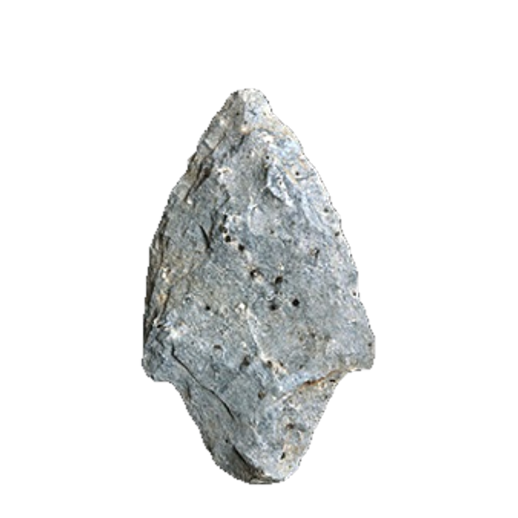
Arrowhead type
Koens Crispin Broadspear Point
Koens Crispin Broadspear10,500 - 9,900 B.P.Transitional Paleo6 reference photos
Key facts
- Age
- 10,500 - 9,900 B.P.
- Cultural period
- Transitional Paleo
- Size
- Large
- Shape
- Contracting Stem
- Glacial period
- Late Pleistocene to Early Holocene
More from the Paleo period
Description
This stem point exhibits a robust morphology, characterized by a medium to large size and a broad, flattened profile. The blade's curvature is predominantly excurvate, although re-sharpening can sometimes impart a recurvate shape. Distinct shoulders are a hallmark of this point, often sloping upward, but occasionally approaching a horizontal orientation. The stem is notably short and tapers inward, while the base displays variability, ranging from pointed to rounded - with the latter being the most prevalent - or convex. The flaking pattern on this point is irregular and non-directional, lacking a discernible orientation.
Size
The dimensions of the arrowheads are as follows: they range in overall length from 44 to 120 mm, with stem lengths varying between 7 and 17 mm. The width of the arrowheads spans from 30 to 48 mm, while the stem width measures between 14 and 20 mm. In terms of thickness, the arrowheads exhibit a range of 5 to 12 mm.
Distribution
This type is mainly located throughout the Eastern Seaboard area, ranging from New York down to Virginia. It can also be discovered with less regularity in other specified regions.
Mainly found in
Also found, less often, in
Additional information
In the realm of Native American arrowhead typology, the Lehigh/Koens-Crispin point presents a notable case of similarity with other point types, particularly the Lehigh Eastern and Snook Hill points. To address the challenges of differentiation, researchers have adopted a combined nomenclature, referring to these points as Lehigh/Koens-Crispin points (W10). This decision is largely based on the work of Kinsey (1972), who highlighted the primary distinguishing feature between these points as the type of material utilized in their construction. Although this webpage treats the Lehigh/Koens-Crispin point as a distinct entity, it is essential to acknowledge that some scholars may consider it as part of a broader category, given the subtle differences between these point types.
The Lehigh/Koens-Crispin point exhibits a temporal overlap with the Savannah River points, which further complicates the process of identification. Within the Savannah River point category, two variants have been identified: the Cattle Run variant, as described by Gier (1996), and the Island Swamp variant, documented by McAvoy and McAvoy (1997). These variants can be difficult to distinguish from the Lehigh/Koens-Crispin point, underscoring the need for careful examination and consideration of multiple characteristics when attempting to classify these artifacts (W10). By recognizing the complexities and nuances of these point types, researchers can gain a deeper understanding of the cultural and historical contexts in which they were created and used.
The challenges of distinguishing between these point types serve as a reminder of the complexities and variations that exist within Native American archaeological record. The Lehigh/Koens-Crispin point, with its similarities to other point types and its temporal overlap with the Savannah River points, highlights the importance of meticulous analysis and consideration of multiple factors when interpreting these artifacts. By continuing to refine our understanding of these point types and their cultural associations, researchers can shed new light on the lives and traditions of the indigenous peoples who created them, ultimately enriching our appreciation of Native American history and culture.
Identified by
- Named by
- E. W. Hawkes, Ralph Liston, and Dorothy Cross
- Year
- 1916
- Type site
- Pre-Lenape Site, New Jersey / Koens - Crispin Site, New Jersey
Similar types
Types that are easy to confuse with the Koens Crispin Broadspear point.
- Adena
- Atlantic Phase
- Morrow Mountain
- Poplar Island
- Schuylkill
- Virginville
Other types in this cluster
- Genesee
- Lehigh Eastern
- Snook Kill