
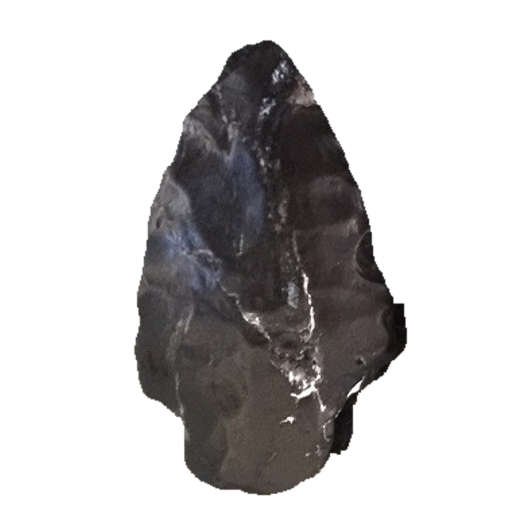
Arrowhead type
Lehigh Eastern Point
Lehigh EasternGenesee Cluster10,500 - 9,900 B.P.Transitional Paleo7 reference photos
Key facts
- Age
- 10,500 - 9,900 B.P.
- Cultural period
- Transitional Paleo
- Size
- Medium to Large
- Shape
- Straight Stem to Contracting Stem
- Glacial period
- Late Pleistocene to Early Holocene
More from the Paleo period
Description
This stem point exhibits a robust morphology, characterized by a medium to large size and a broad, flattened profile. The blade's curvature is predominantly excurvate, although re-sharpening can sometimes impart a recurvate shape. Distinct shoulders are a hallmark of this point, often sloping upward, but occasionally approaching a horizontal orientation. The stem is notably short and tapers inward, while the base displays variability, ranging from pointed to rounded - with the latter being the most prevalent - or convex. The flaking pattern on this point is irregular and non-directional, lacking a discernible orientation.
Size
The arrowheads exhibit a range of dimensions, with overall lengths spanning 44 to 120 mm. The stem, a distinctive feature, measures between 7 and 17 mm in length. In terms of width, these artifacts vary from 30 to 48 mm, while the stem width specifically ranges from 14 to 20 mm. Additionally, the thickness of the arrowheads falls within a range of 5 to 12 mm.
Distribution
This type is mainly located throughout the eastern seaboard, spanning from New York down to Virginia. It can also be discovered, albeit less often, in other specified regions.
Mainly found in
Also found, less often, in
Additional information
In the realm of Native American arrowhead typology, the Lehigh/Koens-Crispin point presents a notable case of similarity with other point types, particularly the Keons-Crispin and Snook Hill points. To address this challenge, researchers have adopted a consolidated approach, opting to refer to these points collectively as the Lehigh/Koens-Crispin point (Kinsey, 1972). This decision is largely driven by the observation that the primary distinguishing feature between these points lies in the type of material utilized in their construction. Although this webpage treats the Keons-Crispin and Snook Hill points as separate entities, it is essential to consider them as part of a broader, unified category.
The Lehigh/Koens-Crispin point exhibits a temporal overlap with the Savannah River point, a phenomenon that underscores the complexities of archaeological classification. Within the Savannah River point category, two distinct variants have been identified: the Cattle Run variant, as described by Gier (1996), and the Island Swamp variant, documented by McAvoy and McAvoy (1997). These variants can be difficult to distinguish from the Lehigh/Koens-Crispin point, highlighting the need for careful analysis and consideration of multiple factors in the identification and classification of these artifacts.
The convergence of these point types in terms of morphology and temporal context serves as a reminder of the dynamic and nuanced nature of Native American cultural expression. By examining the Lehigh/Koens-Crispin point and its relationships with other point types, researchers can gain valuable insights into the technological, social, and cultural developments of the regions and communities that produced these artifacts. As such, continued study and refinement of our understanding of these point types are essential for advancing our knowledge of Native American archaeology and the rich cultural heritage it represents.
Identified by
- Named by
- John Witthoft
- Year
- 1953
Similar types
Types that are easy to confuse with the Lehigh Eastern point.
- Adena
- Atlantic Phase
- Morrow Mountain
- Poplar Island
- Schuylkill
- Virginville
Other types in the Genesee Cluster
- Genesee
- Koens Crispin
- Snook Kill