
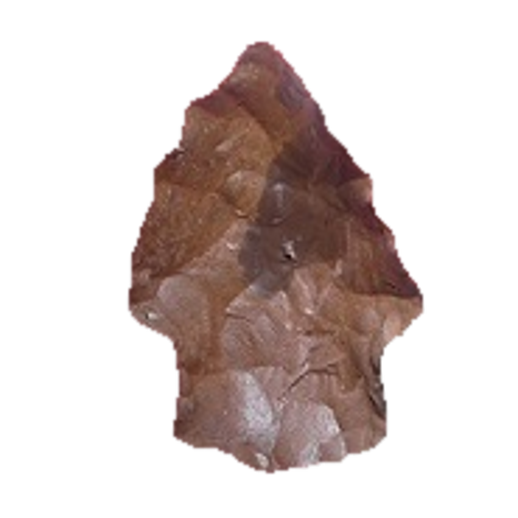
Arrowhead type
Hot Creek Point
Hot CreekMartis Cluster3,100 - 1,500 B.P.Late Archaic to Transitional Archaic2 reference photos
Key facts
- Age
- 3,100 - 1,500 B.P.
- Cultural period
- Late Archaic to Transitional Archaic
- Size
- Medium to Large
- Shape
- Expanding Stem to Straight Stem to Corner Notch
- Glacial period
- Neoglacial to Roman Warm
More from the Archaic period
Description
This triangular point features a distinctive elliptical profile and exhibits a medium to large size range. The blade morphology can vary, displaying either a gently curved excurvate shape or a straight configuration, with larger specimens often presenting a subtly excurvate form. Prolonged re-sharpening can lead to a reduction in blade length, resulting in a straighter blade shape. Many examples of this point type are characterized by the presence of serrations along the blade edges. The shoulder morphology is diverse, ranging from slightly barbed to nearly horizontal, although extensive re-sharpening can cause a reduction in shoulder prominence. The stem exhibits variability, ranging from straight to slightly expanding, with a base that can be straight or mildly convex. The flaking pattern on this point can be oblique, collateral, or random, reflecting the versatility of the manufacturing technique employed in its creation.
Size
The arrowhead's dimensions are as follows: it ranges in overall length from 35 to 85 mm, with the stem section measuring between 10 to 14 mm. The blade itself spans a width of 28 to 42 mm, narrowing to a neck width of 16 to 25 mm, and further expanding to a basal width of 18 to 23 mm. In terms of thickness, the arrowhead measures between 7 to 11 mm.
Distribution
This type is mainly located in the middle section of the Sierra Nevada mountains, spanning California and Nevada.
Mainly found in
Additional information
More information needed.
Identified by
- Named by
- Noel Justice
- Year
- 2002
Similar types
Types that are easy to confuse with the Hot Creek point.
- Cache Creek
- Elko
- Foresthill
- Round Valley
Other types in the Martis Cluster
- Martis
- Tuolumne