
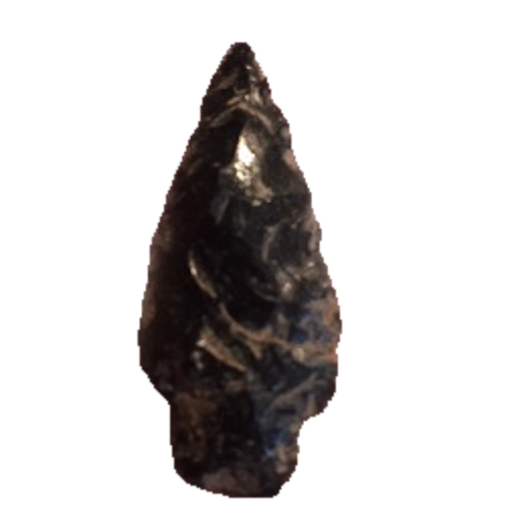
Arrowhead type
Foresthill Point
ForesthillMartis Cluster3,500 - 1,500 B.P.Late Archaic to Transitional Archaic2 reference photos
Key facts
- Age
- 3,500 - 1,500 B.P.
- Cultural period
- Late Archaic to Transitional Archaic
- Size
- Small to Medium
- Shape
- Side Notch to Expanding Stem to Straight Stem
- Glacial period
- Neoglacial to Roman Warm
More from the Archaic period
Description
This projectile point exhibits a triangular to lanceolate silhouette, characterized by an elliptical cross-sectional profile. The blade's curvature is excurvate, with a pronounced inward sweep at the distal tip and a subtle recurvature at the shoulder area. In smaller specimens, the blade may assume a straighter trajectory, resulting in a more triangular overall shape. Serrations may be present along the blade's edge. The side notches are typically shallow and parallel, initiating low on the blade and forming relatively weak shoulders that ascend at an acute angle. Deeper notches may yield more pronounced, horizontally oriented shoulders. The stem expands outward, terminating in a base that ranges from straight to convex. The flaking pattern on this point is random, lacking a discernible pattern or orientation.
Size
The dimensions of the arrowheads are characterized by the following measurements: overall length ranges from 21 to 64 mm, while the stem length spans 8 to 12 mm. The blade width varies between 19 and 33 mm, and the neck width falls within the range of 15 to 30 mm. Additionally, the basal width is measured between 18 and 24 mm, and the thickness of the arrowhead is recorded as 6 to 10 mm.
Distribution
This type is mainly discovered in the middle section of the Sierra Nevada mountains, spanning California and Nevada. They can also be located in the central valleys of California, although at a lower occurrence rate
Mainly found in
Additional information
More information needed.
Identified by
- Named by
- Noel Justice
- Year
- 2002
Similar types
Types that are easy to confuse with the Foresthill point.
- Cache Creek
- Diablo Canyon
- Hot Creek
- Martis
Other types in the Martis Cluster
- Tuolumne