
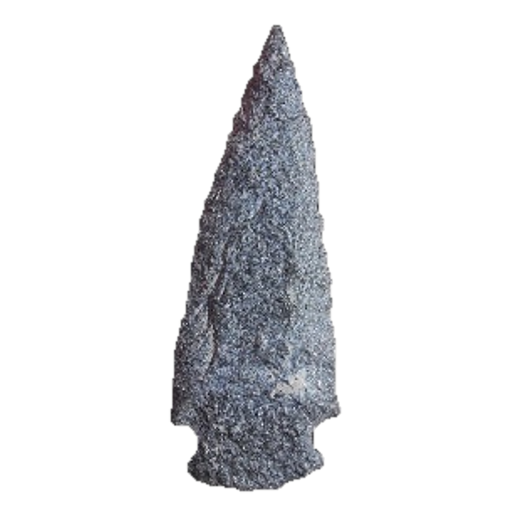
Arrowhead type
Martis Point
MartisMartis Cluster3,000 - 1,350 B.P.Transitional Archaic to Developmental6 reference photos
Key facts
- Age
- 3,000 - 1,350 B.P.
- Cultural period
- Transitional Archaic to Developmental
- Size
- Medium
- Shape
- Side Notch
- Material
- Basalt
- Glacial period
- Neoglacial to Vandal Minimum
More from the Archaic, Developmental periods
Description
This triangular projectile point exhibits a distinctive corner-to-side notch configuration, characterized by an elliptical profile. The blade's curvature is predominantly excurvate, although prolonged re-sharpening can render it straight. The shoulders display a range of morphologies, from subtly barbed to nearly horizontal. The stem expands outward, terminating in a base that is either straight or mildly convex. The flaking pattern on this point is randomized, lacking a discernible order or sequence.
Size
The dimensions of the arrowheads are as follows: they range in overall length from 31 to 93 mm, with stem lengths varying between 10 and 18 mm. The width of the blade spans from 22 to 28 mm, while the neck width measures between 13 and 19 mm. The basal width falls within the range of 16 to 23 mm, and the thickness of the arrowheads is between 6 and 12 mm.
Distribution
This artifact is mainly discovered in the Sierra Nevada mountain range and adjacent areas of California and Nevada. It has also been uncovered as far east as the Humboldt Lake basin in Nevada and as far south as Huntington Lake in California. Additionally, it has been located in the central coastal mountain ranges of California and as far north as Honey Lake in California
Mainly found in
Additional information
In the realm of Native American archaeology, the classification of a particular arrowhead type has sparked debate among scholars. Robert Elston, in his 1994 publication, proposed that this type bears a striking resemblance to the Elko Corner Notched type, suggesting a regional analog. This perspective implies a connection between the two types, with the arrowhead in question potentially representing a localized variation of the Elko Corner Notched style.
However, not all researchers concur with this assessment. Makoto Kowta, in a 1988 study, offered an alternative viewpoint, suggesting that this type is actually an amalgam of distinct forms that share only two commonalities: the use of basalt as a primary material and the employment of Middle Archaic technological methods. According to this interpretation, the similarities between this type and others are superficial, masking a more complex and diverse array of archaeological artifacts.
The discrepancy in opinions highlights the complexities and nuances inherent in the study of Native American arrowheads. The use of basalt and Middle Archaic technology, while significant, may not necessarily imply a direct relationship between different arrowhead types. Further research and analysis are necessary to fully understand the cultural and historical contexts surrounding these artifacts, and to shed light on the intricacies of Native American technological and stylistic developments during the Middle Archaic period.
Identified by
- Named by
- Robert F. Heizer and Albert B. Elsasser
- Year
- 1953
- Type site
- The Martis Site (PLA-5), Martis Valley, Nevada
Similar types
Types that are easy to confuse with the Martis point.
- Clear Lake
- Elko
- Forest Hill
- Hot Creek
- Northern
Other types in the Martis Cluster
- Tuolumne