
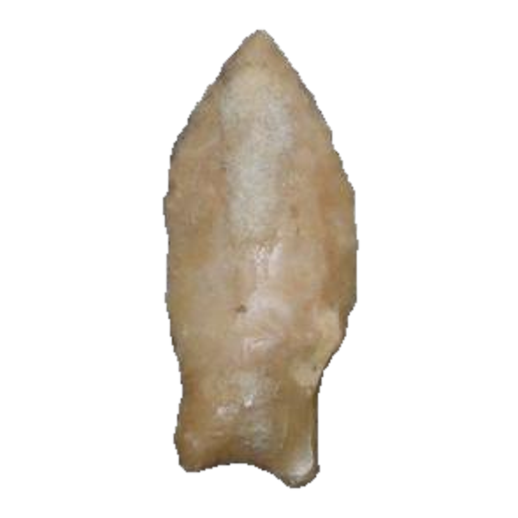
Arrowhead type
Hinds Point
Hinds11,000 - 10,500 B.P.Transitional Paleo11 reference photos
Key facts
- Age
- 11,000 - 10,500 B.P.
- Cultural period
- Transitional Paleo
- Size
- Medium
- Shape
- Auriculate to Lanceolate
- Glacial period
- Early Holocene
More from the Paleo period
Description
This auriculate lanceolate point exhibits a distinctive elliptical profile in cross-section, with a compact, broad blade that displays a pronounced excurvate curvature, where the tip sweeps outward before recurving inward toward the shoulders. The shoulders themselves are angled upward, merging with an expanding stem that creates a pronounced constriction at the waist. The base of the point is characterized by a concave curvature. Evidence of hafting region grinding and basal thinning is apparent, with some specimens displaying a fluted appearance. The flaking pattern on this point is random, lacking a discernible pattern or orientation.
Size
The dimensions of the arrowheads are as follows: they range in overall length from 45 to 72 mm, with a mean length of 50 mm. The portion intended for hafting measures between 15 and 25 mm. The blade itself spans 23 to 40 mm in width, averaging 31 mm. The waist and basal widths are 18 to 28 mm and 20 to 30 mm, respectively. In terms of thickness, the arrowheads measure between 4 and 8 mm, with an average thickness of 6 mm.
Distribution
This type is mainly discovered in the eastern parts of Arkansas and Louisiana, extending to western Tennessee and the northern regions of Alabama
Additional information
More information needed.
Identified by
- Named by
- Samuel O. MaGahey
- Year
- 1981
Similar types
Types that are easy to confuse with the Hinds point.