
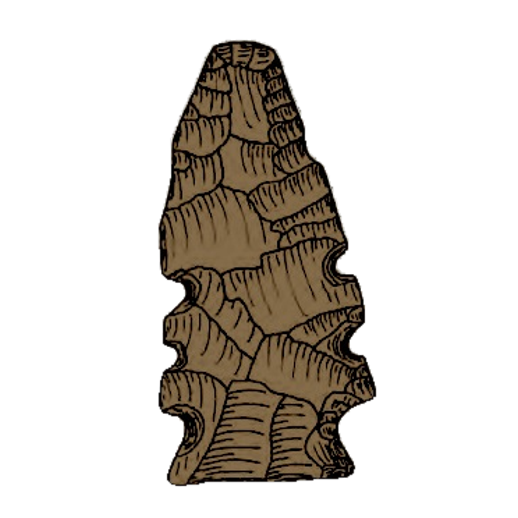
Arrowhead type
St Helena Point
St HelenaKirk Stemmed Cluster6,500 - 5,500 B.P.Early Archaic to Middle Archaic7 reference photos
Key facts
- Age
- 6,500 - 5,500 B.P.
- Cultural period
- Early Archaic to Middle Archaic
- Culture
- Kirk Complex
- Size
- Medium
- Shape
- Expanding Stem to Straight Stem
- Material
- Chert
- Glacial period
- Middle Holocene
More from the Archaic period
Description
This triangular point exhibits a distinctive morphology, characterized by a medium-sized expanding stem and an elliptical profile. The blade section features a series of notches, typically arranged in two or three pairs, and displays a range of curvature, from excurvate to straight, culminating in a tip that can be either obtuse or apiculate, with some examples showing evidence of chiseling. The shoulders of the point are generally oriented horizontally, although some specimens may exhibit upward-sloping or subtly barbed shoulders. The stem itself can vary in orientation, ranging from straight to slightly expanding. The flaking pattern observed on this point is random, lacking a discernible pattern or orientation.
Size
The dimensions of the arrowheads are as follows: they exhibit a total length range of 48 to 78 mm, with a mean length of 62 mm. The stem measures between 7 and 14 mm in length. The blade width varies from 25 to 40 mm, averaging 32 mm. The neck width ranges from 19 to 23 mm, while the stem width falls between 20 and 25 mm. In terms of thickness, the arrowheads measure between 8 and 13 mm, with an average thickness of 9 mm.
Distribution
This type is mainly located in the southeast region of Louisiana and the southwest area of Mississippi.
Mainly found in
Additional information
In the realm of Native American arrowhead typology, a specific point has been identified as a variant of the Kirk Serrated type, a classification first proposed by Gagliano in 1976. This particular point is notable for its evolutionary significance, as it is believed to have given rise to the Tangipahoa point, a development that has been documented by MaGahey in 2000. The Kirk Serrated variant's morphology and characteristics have led researchers to associate it with the broader Kirk Stemmed cluster, despite Justice's 2002 study not explicitly addressing this point within the context of the Kirk Stemmed group. Nevertheless, its inclusion in this cluster is justified due to its shared affinities with other points that are unequivocally part of the Kirk Stemmed tradition.
The classification of this point as a Kirk Serrated variant underscores the complexities and nuances of Native American arrowhead typology, highlighting the need for careful consideration of morphological and chronological factors. The evolutionary link between this point and the Tangipahoa point, as proposed by MaGahey, suggests a dynamic process of technological and cultural exchange among prehistoric communities. Furthermore, the fact that Justice's study does not explicitly mention this point serves as a reminder of the ongoing nature of archaeological research and the potential for reevaluation and refinement of existing typologies.
The Kirk Serrated variant's association with the Kirk Stemmed cluster is significant, as it underscores the importance of considering the broader cultural and historical context in which these artifacts were produced and used. By examining the morphological and stylistic characteristics of this point, researchers can gain valuable insights into the technological, social, and cultural practices of the Native American communities that created them. Ultimately, the study of this point and its relationships to other arrowhead types contributes to a deeper understanding of the complex and dynamic cultural landscape of prehistoric North America.
Identified by
- Named by
- Sherwood M Gagliano
- Year
- 1976
Similar types
Types that are easy to confuse with the St Helena point.
- Jackie
- Heavy Duty Serrated
- Searcy
- St Tammany
- Tangipahoa
Other types in the Kirk Stemmed Cluster
- Heavy Duty
- Jakie Stemmed
- Kirk Stemmed
- Kirk Serrated