
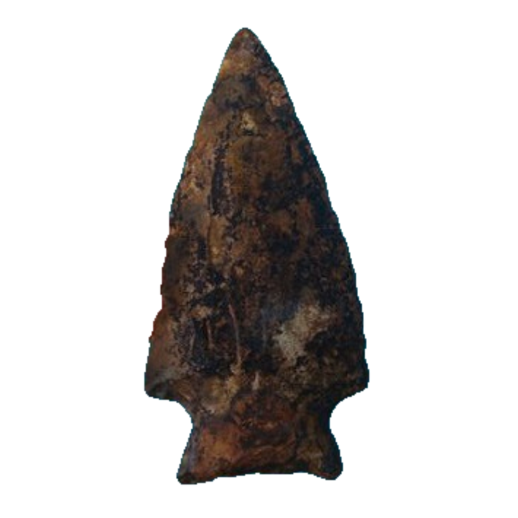
Arrowhead type
Gilchrist Point
Gilchrist9,000 - 7,500 B.P.Early Archaic8 reference photos
Key facts
- Age
- 9,000 - 7,500 B.P.
- Cultural period
- Early Archaic
- Size
- Medium
- Shape
- Expanding Stem to Side Notch to Corner Notch to Bifurcated
- Material
- Coral
- Glacial period
- Early to Middle Holocene
More from the Archaic period
Description
This triangular point exhibits a slender profile, measuring between 1.75 and 3.75 inches in length, with a cross-sectional shape that is elliptical in outline. The blade edge can display a range of curvature, from excurvate to straight. Re-sharpening is a common practice for this point type, which can result in a shoulder that is somewhat diminished, forming a weakly defined shoulder area. The shoulders themselves can display a subtle barb or be angled upward. Characteristically, the stem is short, broad, and expands outward, while the base can be concave, bifurcated, or straight, with basal corners that may be either rounded or sharp. Evidence of grinding in the hafting region is frequently observed. The flaking pattern on this point is random, indicating a lack of deliberate, patterned flaking. Notably, the workmanship on this point is often of high quality, reflecting a skilled level of craftsmanship.
Size
The dimensions of the arrowheads are as follows: they typically range from 35 to 95 mm in overall length, with a mean length of 55 to 65 mm. The stem measures between 9 and 14 mm in length. The blade width varies from 25 to 40 mm, averaging 30 mm. In terms of stem width, the measurements fall within the 22 to 35 mm range. The neck width is between 18 and 24 mm, and the thickness of the arrowhead ranges from 4 to 8 mm.
Distribution
This type is mainly discovered in northern Florida, extending into southern Georgia and southeastern Alabama. It occasionally appears in South Carolina, although such sightings are uncommon
Also found, less often, in
Additional information
The evolution of certain Native American arrowheads is believed to have originated from Dalton or Suwannee technologies, with these points typically exhibiting a thin profile and medium to large size. However, it is not uncommon for these points to undergo re-sharpening, a process that reduces their size and results in a shorter, wider shape, as noted by Granger and Granger in 2013. A notable characteristic of these points is their lack of beveling, a feature observed by Bullen. Nevertheless, research conducted by John Powell in 1990 revealed that beveling can occasionally occur, albeit specifically on the knife form of this point, a finding later supported by Lloyd Schroder in 2012. For a more comprehensive understanding of these arrowheads, additional examples and information can be found through the Florida Museum of Natural History's online resources, including the webpage dedicated to the Gilchrist collection.
The absence of beveling on these points is a distinctive feature that sets them apart from other arrowhead types. However, the exception to this rule, as observed by Powell, highlights the complexity and variability of Native American lithic technologies. The re-sharpening process, which alters the point's size and shape, also underscores the resourcefulness and practicality of the cultures that created these tools. By examining the characteristics and variations of these arrowheads, researchers can gain valuable insights into the technological, cultural, and historical contexts in which they were produced and used.
Further study of these arrowheads, including their morphological characteristics and cultural associations, can provide a deeper understanding of the lives and traditions of the Native American communities that created them. The work of scholars such as Bullen, Powell, and Schroder has contributed significantly to our knowledge of these artifacts, and continued research in this field is essential for advancing our understanding of the rich and diverse cultural heritage of Native American societies. By exploring the complexities and nuances of these arrowheads, we can gain a more nuanced appreciation for the ingenuity, creativity, and resilience of the people who crafted them.
Identified by
- Named by
- Ripley P. Bullen
- Year
- 1975
Similar types
Types that are easy to confuse with the Gilchrist point.