
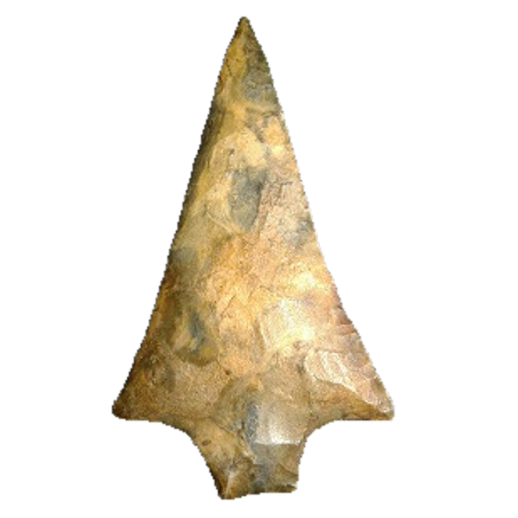
Arrowhead type
Gibson Beveled Point
Gibson BeveledArchaic Stemmed Cluster8,000 - 5,000 B.P.Early Archaic to Middle Archaic6 reference photos
Key facts
- Age
- 8,000 - 5,000 B.P.
- Cultural period
- Early Archaic to Middle Archaic
- Size
- Small to Medium to Large
- Shape
- Contracting Stem
- Material
- Chert
- Glacial period
- Middle Holocene
More from the Archaic period
Description
This slender, compact point measures between 1 to 3 inches in length, characterized by a tapering stem and a thin, delicate cross-section. The blade profile is predominantly straight, although some specimens may exhibit a subtle excurvate or incurvate-recurvate curvature, particularly on re-sharpened examples. Notably, the blade displays right-handed beveling, with edge morphology ranging from finely serrated to plain. The transition between the stem and shoulder is typically marked by a smooth, sweeping curve, while some instances may feature a more abrupt, angular junction. Shoulder orientation varies, spanning from horizontal to upwardly angled. The stem itself may be straight or slightly contracting, terminating in a base that is often straight, but can also be slightly convex or concave. The point's manufacture is distinguished by meticulous percussion flaking, supplemented by fine, pressure flaking along the right edge, yielding a random, yet precise, flaking pattern. The presence of right-handed beveling is a defining characteristic of this point type.
Size
The dimensions of the arrowheads are characterized by the following measurements: overall length ranges from 25 to 75 mm, with a typical span of 50 to 60 mm. The stem measures between 6 and 11 mm in length, while the blade width falls within the range of 28 to 40 mm. Additionally, the stem width is observed to be between 15 and 22 mm.
Distribution
This type is predominantly discovered in the Tampa Bay area and throughout middle Florida.
Mainly found in
Additional information
In the realm of Native American arrowheads, the Gibson point is a notable example of technological sophistication. One of its distinctive characteristics is the frequent use of heat treatment, which enables the creation of a remarkably thin and refined point. The manufacturing process involves a combination of techniques, including random percussion flaking and fine pressure flaking, the latter of which is often meticulously applied to the right edge of the point. Additionally, some Gibson points exhibit fine serrations, further testament to the craftsmanship of their creators.
The morphology of the Gibson point is also worthy of note. The shoulder of the point, where it meets the stem, is marked by a wide, curved transition, which sets it apart from other types of arrowheads. Furthermore, the stem itself is characteristically shorter than that of the standard Hardee type, a distinction that can be useful in identifying and classifying these artifacts. The base of the Gibson point stem is typically straight or slightly convex, providing a stable platform for attachment to a shaft.
The Gibson point's unique combination of technological and morphological features makes it an important subject of study in the field of archaeology. By examining these characteristics, researchers can gain insights into the cultural and historical contexts in which these arrowheads were created and used. The fact that Gibson points were often heat-treated, for example, suggests a high degree of technical expertise and a desire to produce a durable, effective hunting tool. As such, the study of Gibson points offers a fascinating window into the lives and traditions of Native American communities, and highlights the importance of continued research and preservation of these remarkable artifacts.
Identified by
- Named by
- James Gray
- Year
- 1975
Similar types
Types that are easy to confuse with the Gibson Beveled point.
Other types in the Archaic Stemmed Cluster
- Hardee