
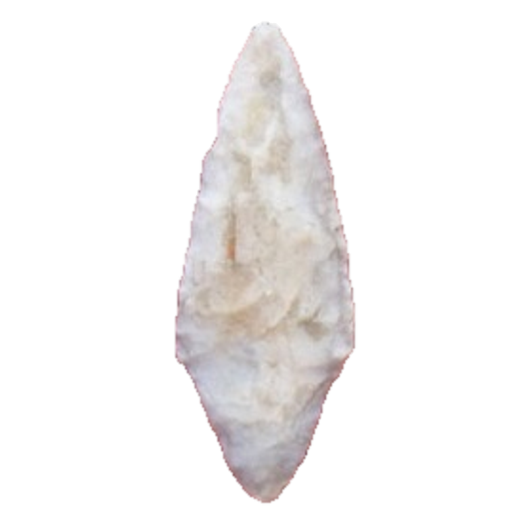
Arrowhead type
Gatecliff Stemmed Point
Gatecliff StemmedGypsum Cave Cluster5,000 - 3,000 B.P.Middle Archaic to Late Archaic18 reference photos
Key facts
- Age
- 5,000 - 3,000 B.P.
- Cultural period
- Middle Archaic to Late Archaic
- Size
- Medium
- Shape
- Contracting Stem
- Glacial period
- Middle Holocene to Neoglacial
More from the Archaic period
Description
The medium-sized point exhibits a cross-sectional profile that transitions from flattened to elliptical in shape. Its blade morphology varies, ranging from excurvate to straight, and may feature serrations. The shoulder orientation is typically inclined upward, although instances with horizontal or barbed shoulders are also observed. The stem narrows, terminating in a base that is either straight or convex. Notably, basal grinding is rarely present on this point type. The flaking pattern on this point is often characterized by a random arrangement, but can also exhibit oblique flaking in some instances.
Size
The dimensions of the arrowheads are as follows: they range in overall length from 34 to 53 mm, with a mean length of 42 mm. The stem measures between 9 and 14 mm in length. The blade width varies from 21 to 27 mm, averaging 24 mm. At the shoulders, the stem width ranges from 11 to 28 mm. In terms of thickness, the arrowheads measure between 3 and 5 mm.
Distribution
This type is mainly discovered throughout the Great Basin region, stretching eastwards to the Colorado River, and continuing southwards along the Colorado River to California
Additional information
The arrowheads in question were previously categorized under the Gypsum type, a classification that highlights their shared characteristics with other points of this designation. This typological association is significant, as it underscores the cultural and technological affinities between these artifacts and others of the same class. By examining the morphological and metric attributes of these points, researchers can gain a deeper understanding of the historical context in which they were crafted and utilized.
Notably, the Gypsum type is characterized by a distinct set of features, including a specific shape, size, and stylistic motif. The inclusion of these arrowheads within this type suggests that they were likely manufactured during a particular time period, possibly between certain dates, although the exact chronology is not specified in the available information. Furthermore, the cultural associations of the Gypsum type can provide valuable insights into the technological, social, and economic dynamics of the societies that produced these artifacts.
The study of these arrowheads, as part of the Gypsum type, offers a unique window into the lives and traditions of the Native American communities that created them. By analyzing the characteristics of these points, archaeologists can reconstruct aspects of the cultural, technological, and environmental contexts in which they were used, ultimately contributing to a more nuanced understanding of the complexities and diversity of Native American cultures.
Identified by
- Named by
- David H. Thomas
- Year
- 1981
- Type site
- Gatecliff Shelter, Nevada
Similar types
Types that are easy to confuse with the Gatecliff Stemmed point.
- Ano Nuevo
- Coquille
- Gypsum
- Parowan
- Santa Cruz
- Vandenberg