
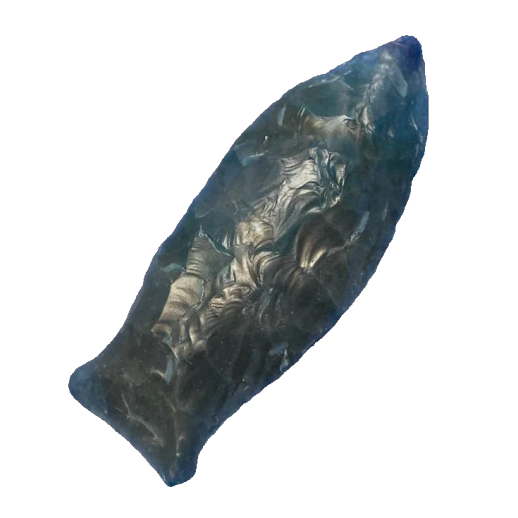
Arrowhead type
Dry Brook Fishtail Point
Dry Brook FishtailSusquehanna Cluster3,200 - 2,600 B.P.Late Archaic to Early Woodland10 reference photos
Key facts
- Age
- 3,200 - 2,600 B.P.
- Cultural period
- Late Archaic to Early Woodland
- Size
- Small to Medium
- Shape
- Expanding Stem to Side Notch
- Glacial period
- Neoglacial
Description
This lanceolate point exhibits a size range from small to medium, characterized by an expanding stem that broadens towards the base. In cross-section, the point's profile shifts between a flattened and elliptical shape. The blade itself displays an excurvate curvature, although instances that have undergone re-sharpening may exhibit asymmetry. The shoulders of the point are gently rounded and incline upward, forming a subtle slope. While the stem is typically expanding, some specimens feature straight stems, showcasing variability within this type. The base of the point is predominantly concave, although it can also appear straight in certain examples. Notably, the base often presents a fishtail-like appearance, while some instances may display a more articulated or segmented look. A common feature of this point type is the presence of basal grinding, which suggests deliberate edge modification. The flaking pattern observed on this point is random, indicating a lack of deliberate, patterned flaking during its manufacture.
Size
The arrowheads exhibit a range of dimensions, with lengths spanning 38 to 102 mm, and an average length of 60 mm. The stem, measured from the base to the shoulder or blade junction, ranges from 13 to 20 mm in length. In terms of width, the blade measures between 18 and 25 mm, while the neck and stem widths are 12 to 17 mm and 14 to 20 mm, respectively. The thickness of the arrowheads varies from 5 to 11 mm.
Distribution
This artifact is mainly located in the southern region of New England and is a prevalent style in New York, Pennsylvania, and adjacent territories. It can also occur with less regularity in other specified regions.
Additional information
In comparing the morphological characteristics of Native American arrowheads, notable distinctions emerge between the Orient and Drybrook point types. A key difference lies in the overall proportions, with the Orient point typically exhibiting a more slender profile. Furthermore, the shoulders of the Orient point are generally rounded, whereas those of the Drybrook point are more angular. This contrast in shoulder morphology is a significant diagnostic feature, allowing for the differentiation between these two point types. The Orient point also tends to have a more sloped appearance, which, in conjunction with its rounded shoulders, sets it apart from the Drybrook point. These characteristics, as observed in specimens such as those categorized as W10, underscore the importance of careful analysis in identifying and distinguishing between various arrowhead types.
Identified by
- Named by
- David J. Werner
Similar types
Types that are easy to confuse with the Dry Brook Fishtail point.
- Forest
- Frost Island
- Orient Fishtail
- Patuxent
- Susquehanna Broad Spear