
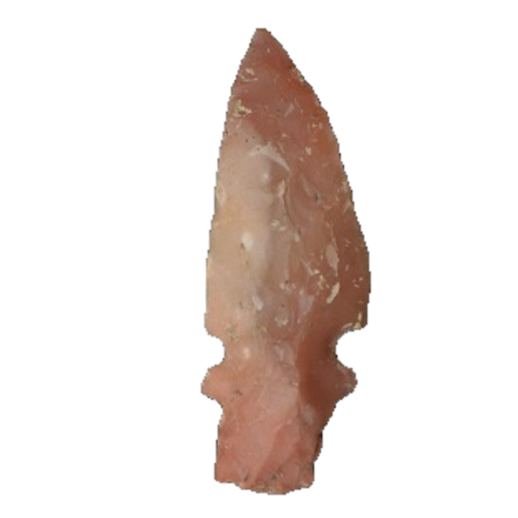
Arrowhead type
Evans Double Notch Point
Evans Double Notch5,350 - 3,000 B.P.Middle Archaic to Early Woodland22 reference photos
Key facts
- Age
- 5,350 - 3,000 B.P.
- Cultural period
- Middle Archaic to Early Woodland
- Culture
- Big Creek Culture
- Size
- Medium
- Shape
- Side Notch
- Glacial period
- Middle Holocene to Neoglacial
Description
This triangular point, measuring between 1.25 and 2.5 inches in length, exhibits an elliptical cross-sectional profile and a blade that can vary from excurvate to straight in its broadness. A distinctive feature of this point is the presence of notches situated above the shoulders, which can occur on one or both blades. The shoulders themselves display a range of forms, from slightly barbed to a subtle upward inclination. The stem's shape is predominantly slightly expanding, although it can also be straight or, less commonly, slightly contracting. The base of the point can be either straight or slightly convex, and may exhibit basal grinding. The flaking pattern on this point is characterized by a random arrangement of flakes.
Size
The arrowheads exhibit a range of dimensions, with overall lengths spanning 32 to 65 mm, averaging 52 mm. The stem section measures between 10 and 15 mm in length, while the maximum width of the arrowhead itself ranges from 20 to 36 mm. The width of the stem is narrower, falling within the range of 14 to 22 mm. In terms of thickness, the arrowheads are between 5 and 8 mm thick.
Distribution
This type is mainly discovered in northern Louisiana and extending into southern Arkansas and eastern Texas. They are also located with less regularity in the Tennessee River Valley and the central Mississippi River Valley
Also found, less often, in
Additional information
The archaeological record indicates that a particular type of arrowhead is predominantly linked to the Middle to Late Archaic periods, a timeframe that spans several centuries. Notably, research conducted by Johnson et al. in 2002 uncovered evidence suggesting that this point type was also present during the Early Woodland period, thus broadening its chronological range. A related point type, known as the Sinner point, exhibits a distinctive characteristic: the presence of multiple notches on the blade, as documented by Johnson et al. in their 2002 study.
Further examination of regional variants reveals that the Tangipahoa point is closely related to the Evans point, with a notable exception: the Tangipahoa point features a contracting base. This specific variant has been found in Louisiana, highlighting the geographic diversity of arrowhead types across different regions. The study of these point types provides valuable insights into the technological and cultural developments of Native American communities during the Archaic and Woodland periods.
The analysis of these arrowhead types underscores the complexity and variability of Native American lithic technology, with different regions and time periods yielding distinct point types. The presence of multiple notches on the Sinner point and the contracting base of the Tangipahoa point demonstrate the innovative and adaptive approaches employed by Native American communities in crafting their tools. By examining these point types and their variants, researchers can gain a deeper understanding of the cultural and technological exchanges that occurred among Native American groups, ultimately enriching our knowledge of their history and traditions.
Identified by
- Named by
- James A. Ford and Clarence H. Webb
- Year
- 1956
- Type site
- Poverty Point, West Carroll Parrish, Louisiana
Similar types
Types that are easy to confuse with the Evans Double Notch point.