
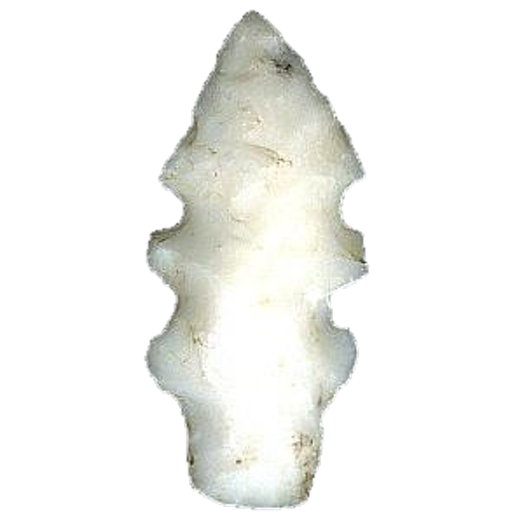
Arrowhead type
Duran Point
Duran3,000 - 2,000 B.P.Late Archaic to Transitional Archaic12 reference photos
Key facts
- Age
- 3,000 - 2,000 B.P.
- Cultural period
- Late Archaic to Transitional Archaic
- Size
- Small to Medium
- Shape
- Side Notch to Straight Stem
- Material
- Quartz
- Glacial period
- Late to Transitional Archaic
More from the Archaic period
Description
This triangular point exhibits a distinctive morphology, characterized by a medium to small size and an elliptical profile. The blade's curvature can range from straight to gently outward, with one or more notches situated above the shoulder, which may impart a serrated appearance due to shallow, closely spaced indentations. The shoulder itself can be oriented horizontally or display a subtle, barbed inclination. The stem's shape varies, expanding slightly or remaining straight, while the base can be either convex or straight. The flaking pattern on this point is characterized by a random, non-patterned arrangement of flakes.
Size
The arrowhead's dimensions are characterized by the following measurements: its overall length ranges from 25 to 50 mm, while the stem measures between 5 to 10 mm in length. The blade's width spans 15 to 25 mm, and the neck width is between 6 to 11 mm. Additionally, the maximum width of the stem is recorded as 8 to 15 mm.
Distribution
This type is predominantly located in Chihuahua and extends into Coahuila, Sonora, and Durango Mexico. It is also discovered in southern Arizona, New Mexico, and western Texas, albeit less often. It may occasionally appear in southwestern Colorado, where its presence is relatively rare
Additional information
Upon examination, the arrowhead in question bears a striking resemblance to the Howard point, a type of projectile point characterized by its compact and slender profile. Notably, the subject point is smaller in size and narrower in width compared to other examples of its kind, aligning with the distinctive morphological traits of the Howard point. This similarity suggests a potential cultural and chronological affinity between the two, warranting further investigation into the point's origins and significance within the context of Native American archaeology.
The Howard point is a significant artifact in the study of Native American cultures, and its characteristics have been well-documented in archaeological literature. By comparing the subject point to the Howard point, researchers can gain valuable insights into the technological, social, and cultural developments of the communities that created these artifacts. The smaller and narrower dimensions of the subject point may indicate a specific function or purpose, such as hunting small game or serving as a component of a larger hunting tool.
Further analysis of the subject point, including its material composition, manufacturing techniques, and contextual associations, will be essential in determining its precise cultural and chronological placement within the broader narrative of Native American archaeology. Nevertheless, the initial observation of its similarity to the Howard point provides a crucial starting point for understanding the point's significance and potential contributions to our knowledge of Native American cultures and technologies.
Identified by
- Named by
- Walter W. Taylor
- Year
- 1966
Similar types
Types that are easy to confuse with the Duran point.
- Bokoshe
- Charco
- Chocoville
- Cueva de la Nopalera I
- Evans
- Guadalupe
- Howard
- Livermore
- Neff
- Sinner