
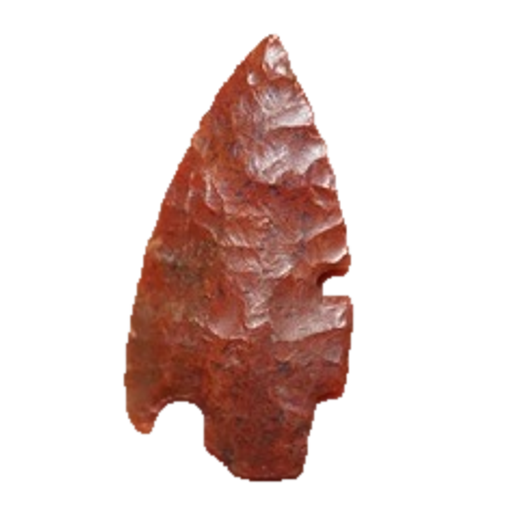
Arrowhead type
Charcos Point
Charcos3,000 - 2,000 B.P.Late Paleo to Transitional Archaic10 reference photos
Key facts
- Age
- 3,000 - 2,000 B.P.
- Cultural period
- Late Paleo to Transitional Archaic
- Size
- Small to Medium
- Shape
- Side Notch to Basal Notch to Corner Notch to Straight Stem
- Glacial period
- Neoglacial Roman Warm
Description
This triangular stemmed point exhibits a compact to moderate size, characterized by an elliptical cross-sectional profile. The blade's curvature is predominantly convex, featuring a distinctive notch situated just above the shoulder on one of the blades. The blades display asymmetry, with the notched blade having a straighter edge compared to the un-notched blade. The shoulder morphology differs between the two blades, with the un-notched blade bearing barbed shoulders and the notched blade displaying shoulders that are either horizontal or slightly barbed. The stem's shape can vary, ranging from straight to slightly expanding, and its cross-sectional profile may be straight or slightly convex. The flaking pattern on this point appears to be random, lacking a consistent or organized arrangement.
Size
The dimensions of the arrowheads are characterized by the following measurements: overall length ranges from 30 to 55 mm, with a typical average span of 35 to 45 mm. The stem measures between 5 and 11 mm in length. The blade's width varies from 18 to 33 mm, while the neck width falls within the range of 7 to 15 mm. At the base, the width is between 8 and 17 mm.
Distribution
This type is mainly located in northern Mexico and extends into the Big Bend area of Texas. It can also be discovered in southern Texas and southern New Mexico, albeit with less regularity.
Mainly found in
Additional information
In the realm of Native American arrowheads, notable variations exist within specific point types. Research by Turner and Hester, published in 1985, highlights two distinct subsets of these points. One variant is characterized by the presence of double notches on the blade, a unique feature that distinguishes it from other types. Conversely, another variant lacks any notching on the blade altogether, showcasing the diversity within this particular point style. These variations underscore the complexity and nuance of Native American arrowhead design, reflecting the ingenuity and adaptability of their creators. By examining these subtle differences, archaeologists can gain a deeper understanding of the cultural and historical contexts in which these artifacts were crafted.
Identified by
- Named by
- Lorraine Heartfield
- Year
- 1975
- Type site
- Multiple sites, Coahuila, Mexico
Similar types
Types that are easy to confuse with the Charcos point.