
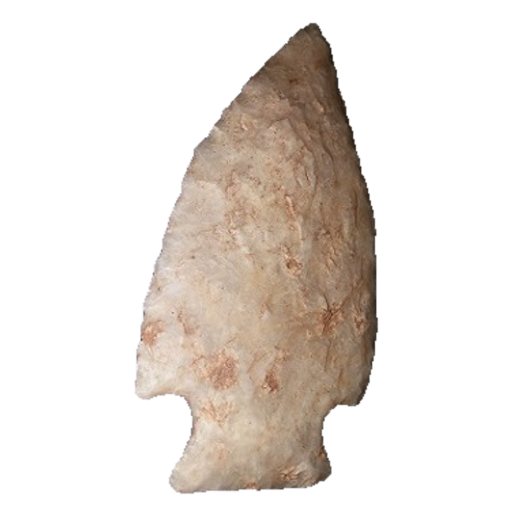
Arrowhead type
Elko Side Notch Point
Elko Side NotchNorthern Side Notch Cluster3,500 - 1,400 B.P.Late Archaic to Transitional Archaic16 reference photos
Key facts
- Age
- 3,500 - 1,400 B.P.
- Cultural period
- Late Archaic to Transitional Archaic
- Size
- Small to Medium
- Shape
- Side Notch
- Glacial period
- Neoglacial to Roman Warm
More from the Archaic period
Description
This triangular side-notched point exhibits a compact to moderate size, characterized by a cross-sectional profile that transitions from flattened to elliptical. The blade's curvature can vary, ranging from a subtle excurvate shape to a straight edge. A distinctive feature of these points is the presence of fine serrations along the blade's edge. The shoulders display a range of orientations, from a horizontal alignment to a pronounced upward inclination. The stem expands outward, terminating in a base that is either straight or subtly concave. In terms of flaking patterns, this point typically displays a random arrangement of flakes, although some specimens may exhibit a more organized parallel oblique pattern.
Size
The dimensions of these arrowheads are characterized by the following measurements: overall length ranges from 24 to 88 mm, with a mean length of 33 to 51 mm. The stem measures between 7 to 11 mm in length. The blade width varies from 15 to 52 mm, averaging between 18 to 24 mm. The neck width spans 10 to 32 mm, typically falling within the range of 13 to 17 mm. The stem width ranges from 13 to 42 mm, generally being 10 to 20 mm narrower than the blade width. In terms of thickness, the arrowheads measure between 4 to 9 mm.
Distribution
This type is distributed across the Great Basin region, extending into the Snake River Valley and southeastern Oregon's Klamath Valley. It also appears in the northern sector of the Colorado Plateau. The range stretches westward to the Sacramento River Valley. Additionally, it reaches southward into northern Baja California and northwestern Sonora Mexico
Also found, less often, in
Additional information
In an effort to elucidate the nuances between the Elko Corner Notch and the Elko Side Notch, Homer's 1980 study employed statistical analysis to determine if a distinct difference existed between the two forms. The findings suggested that, rather than being discrete entities, the Elko Corner Notch and Elko Side Notch may represent a continuous spectrum, with no clear-cut distinction between them. This lack of a discernible difference has sparked further investigation into the potential factors contributing to the variation in notch placement.
One possible explanation for the emergence of the Side Notch form is that it may be an artifact of re-sharpening the blade, which could have altered the original notch configuration. Alternatively, as proposed by Justice in 2002, the difference in notch placement may be attributed to a deliberate design choice, where the notches were positioned higher on the blade to optimize basal width. This intentional placement would have allowed for a more efficient use of the available stone material, highlighting the resourcefulness and adaptability of the craftsmen who created these arrowheads.
The Elko Corner Notch and Elko Side Notch forms, whether representing a continuum or distinct design choices, offer valuable insights into the technological and cultural practices of the populations that created them. By examining the variations in notch placement and blade morphology, researchers can gain a deeper understanding of the complex factors that influenced the development and use of these arrowheads, ultimately shedding light on the lives and traditions of the people who crafted them.
Identified by
- Named by
- Robert F. Heizer and Martin A. Baumhoff
- Year
- 1961
- Type site
- South Fork Shelter, Elko County, Nevada
Similar types
Types that are easy to confuse with the Elko Side Notch point.
- Cold Springs
- Coquille
- Diablo Canyon
- Merrybelle
- Northern
- Sudden
Other types in the Northern Side Notch Cluster
- Elko Corner Notch
- Elko Eared
- Elko Split Stem
- Northern Side Notch
- San Rafael
- Sudden Shelter
- Ventana Side Notch