
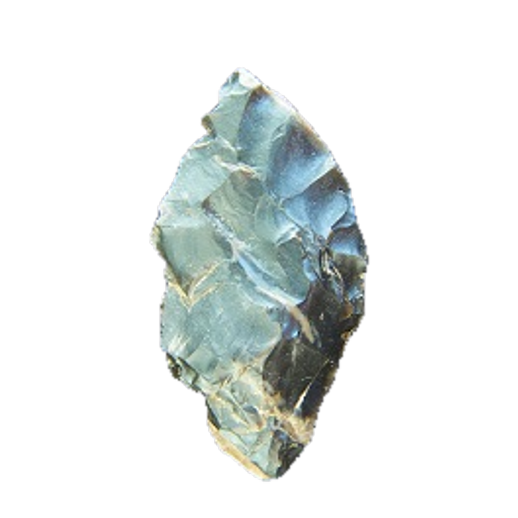
Arrowhead type
Ebenezer Point
Ebenezer2,000 - 1,500 B.P.Woodland6 reference photos
Key facts
- Age
- 2,000 - 1,500 B.P.
- Cultural period
- Woodland
- Size
- Small
- Shape
- Contracting Stem to Straight Stem
- Glacial period
- Roman Warm
More from the Woodland period
Description
This diminutive point, typically measuring 1.5 inches in length, exhibits a triangular form with a contracting stem and an elliptical cross-sectional profile. The blade's curvature is predominantly excurvate, although some specimens may display a nearly straight edge. The shoulders are often subdued or entirely absent, and when present, may be oriented horizontally or at a slight upward inclination. The stem is characterized by its brevity and contracting shape, terminating in a base that ranges from straight to convex. Flaking patterns on this point type are random and lack a discernible order. Notably, many examples of this point type are crudely fabricated, suggesting a lack of refinement in their manufacture.
Size
The dimensions of the arrowheads are as follows: they exhibit a total length ranging from 30 to 42 mm, with stem lengths varying between 8 and 14 mm. The width of the blade spans from 15 to 28 mm, while the thickness measures between 7 and 10 mm, as determined from a limited dataset.
Distribution
This type is mainly discovered in the Tennessee River Valley of southern Tennessee and extending into northern Alabama.
Mainly found in
Also found, less often, in
Additional information
In the realm of Native American archaeology, a specific type of arrowhead has been identified and characterized based on its discovery at a key site. Initially referred to as "Rudimentary Stemmed," this point type was first described by Cambron in 1969. Notably, his research revealed that this particular point was the predominant form found at the Camp Creek site, situated along the French Broad River. This river is significant, as it is part of the larger Tennessee River headwaters system. The prevalence of Rudimentary Stemmed points at this location underscores their importance within the regional archaeological record, providing valuable insights into the technological and cultural practices of the Native American groups that inhabited this area.
The Camp Creek site, with its abundance of Rudimentary Stemmed points, offers a unique window into the lives of these ancient peoples. The fact that this point type was so prevalent at the site suggests a high degree of cultural continuity and technological consistency among the groups that utilized this location. Furthermore, the association of these points with the French Broad River and the Tennessee River headwaters highlights the significance of aquatic resources and transportation routes in the lives of these Native American communities. By examining the characteristics and distribution of Rudimentary Stemmed points, archaeologists can gain a deeper understanding of the cultural and environmental contexts in which they were created and used.
The study of Rudimentary Stemmed points, as exemplified by those found at the Camp Creek site, contributes to a broader understanding of Native American technological and cultural development. Through the analysis of these artifacts, researchers can reconstruct the technological, social, and environmental dynamics that shaped the lives of these ancient communities. As such, the Rudimentary Stemmed point type remains an important area of study within the field of Native American archaeology, offering a fascinating glimpse into the lives and traditions of the peoples who created and utilized these distinctive arrowheads.
Identified by
- Named by
- Madeline Kneberg
- Year
- 1957
- Type site
- Camp Creek, Greene County, Tennessee
Similar types
Types that are easy to confuse with the Ebenezer point.