
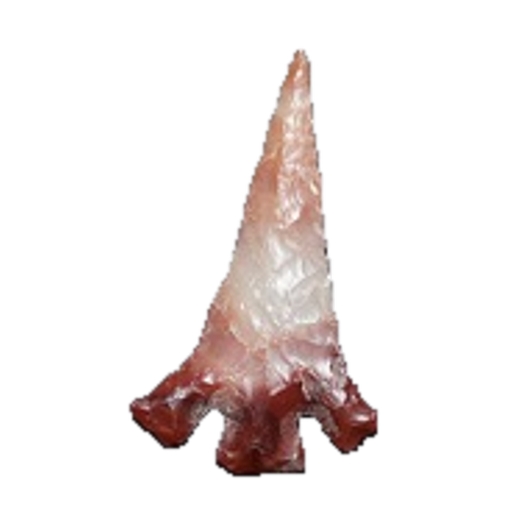
Arrowhead type
Eastgate Barbed Point
Eastgate BarbedRosegate Cluster1,500 - 1,100 B.P.Late Prehistory to Developmental13 reference photos
Key facts
- Age
- 1,500 - 1,100 B.P.
- Cultural period
- Late Prehistory to Developmental
- Culture
- Fremont, Anasazi , Shoshone Culture
- Size
- Small to Medium
- Shape
- Basal Notch to Corner Notch
- Glacial period
- Roman Warm to Vandal Minimum
More from the Late Prehistoric, Developmental periods
Description
This triangular basal notch point exhibits a distinctive morphology, characterized by a slender profile and a cross-sectional shape that has been deliberately flattened. The blade's curvature can vary, ranging from a subtle outward curve to a more pronounced inward bend. Notably, the blade edges tend to broaden at the shoulder, forming a pronounced flare. The shoulders themselves are typically squared in shape, although they can become more pointed as the tool is resharpened, and are often adorned with barbs that extend downward to the base of the point. The stem of this point is most often expanding in shape, although it can also be straight, and the base can exhibit a range of shapes, from straight to gently convex. Overall, this point is typically crafted with care, featuring a random flaking pattern that reflects the skill of its creator.
Size
The arrowheads exhibit a range of dimensions, with total lengths spanning 16 to 61 mm, and averaging between 33 to 43 mm. The stem, which comprises a portion of the overall length, measures between 4 to 6 mm. In terms of blade dimensions, the width varies from 14 to 35 mm, with an average range of 20 to 25 mm. At the shoulders, the stem width ranges from 5 to 9 mm, while the overall thickness of the arrowheads falls between 3 to 6 mm.
Distribution
This projectile is distributed across the Great Basin region and extends into the northern sector of the Colorado Plateau. Its northern boundary is marked by the Snake River Plain, its eastern edge is defined by the Colorado River valley, its western limit is bounded by Death Valley and eastern California
Mainly found in
Additional information
The emergence of the bow and arrow technology in the Great Basin region marks a significant milestone in the evolution of Native American projectile points. Notably, the Rosegate Cluster, a type designation coined by David H. Thomas in 1981, represents a crucial transitional phase in this development. By consolidating the characteristics of the Rose Springs and Eastgate types, Thomas highlighted the overlapping features of these two point styles. The Rosegate Cluster is distinguished by its similarity to the Rose Springs point, albeit with notable differences, including the presence of square barbs, which are typically absent in Rose Springs points. Furthermore, Rosegate points tend to be wider than their Rose Springs counterparts, with distinct notch placements that set them apart. While Rose Springs points have notches that enter the blade at a lower point, effectively shortening the length of the original preform blade, Eastgate points have notches that originate from the base, preserving the full length of the blade.
The Rosegate Cluster, comprising both Rose Springs and Eastgate types, is an extension of the earlier Elko Corner Notch type, adapted to accommodate the shift from dart points to arrow points. This technological transition is a hallmark of the Great Basin region during this period. As noted by Justice in 2002, the Rosegate Cluster was eventually supplanted by other point styles, including the Desert series and Cottonwood points. The chronological placement of the Rosegate Cluster is significant, with Homer and Weder (1980) dating its appearance to between 500-800 A.D., preceding the emergence of the Parowan type point. This temporal context suggests that the Rosegate Cluster may have played a pivotal role in the evolution of subsequent point styles, potentially influencing the development of the Parowan type point.
The study of the Rosegate Cluster offers valuable insights into the technological and cultural dynamics of the Great Basin region during this period. By examining the characteristics and chronological placement of this point style, researchers can gain a deeper understanding of the adaptive strategies employed by Native American communities as they transitioned to the bow and arrow technology. The Rosegate Cluster's position within the broader context of Great Basin archaeology underscores the complexity and nuance of this technological shift, highlighting the need for continued research and analysis to fully appreciate the significance of this pivotal moment in Native American cultural and technological development.
Identified by
- Named by
- Robert F. Heizer and Martin A. Baumhoff
- Year
- 1961
- Type site
- Eastgate Cave, Churchill County, Nevada
Similar types
Types that are easy to confuse with the Eastgate Barbed point.
Other types in the Rosegate Cluster
- Eastgate Expanding Stem
- Eastgate Split Stem
- Parowan Basal Notch
- Rose Springs Corner Notch
- Rose Springs Side Notch
- Rose Springs Stemmed