
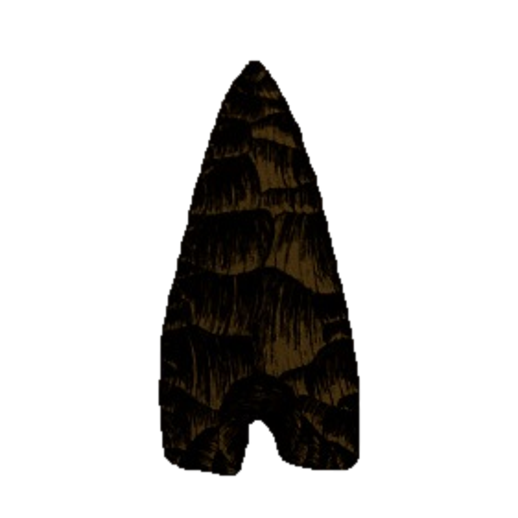
Arrowhead type
Carrizo Point
Carrizo5,000 - 3,000 B.P.Middle Archaic to Late Archaic12 reference photos
Key facts
- Age
- 5,000 - 3,000 B.P.
- Cultural period
- Middle Archaic to Late Archaic
- Size
- Small to Medium to Large
- Shape
- Triangle to Basal Notch
- Glacial period
- Middle Holocene to Neoglacial
More from the Archaic period
Description
This triangular point exhibits a distinctive morphology, characterized by a medium size and a cross-sectional shape that transitions from flattened to elliptical. The blade's profile is predominantly excurvate, while the base displays variability, ranging from a subtle convexity to a straight edge. A notable feature is the presence of a central basal notch, which can be found on bases that are either straight or slightly convex. The basal corners tend to be rounded, and the base is often thinned through the removal of short longitudinal flakes. The flaking pattern is typically fine-grained, with a random arrangement of flakes that lacks a discernible order.
Size
The dimensions of the arrowheads are characterized by a total length ranging from 25 to 90 mm, with a mean length typically falling between 40 to 55 mm. Additionally, the blade width spans from 22 to 38 mm.
Distribution
This type is mainly discovered in southern Texas, predominantly within Dimit, Zavala, Frio, and LaSalle Counties. Its presence is less common as it extends into central Texas
Mainly found in
Additional information
In the realm of Native American arrowhead identification, it is essential to consider the similarities between various point types. Notably, the Montell point, characterized by its distinctive square-shaped stem, can exhibit a "bucktooth" appearance, particularly in its basal morphology. This unique feature is reminiscent of the stem morphology observed in other point types, such as those depicted in the second and third illustrations. According to John Haberer, a worn or exhausted Montell point can assume a similar appearance to other point types, highlighting the importance of careful examination and consideration of multiple characteristics when attempting to identify and classify Native American arrowheads.
The Montell point's square "bucktooth" stem is a diagnostic feature that sets it apart from other point types. This distinctive morphology is a key characteristic that archaeologists use to identify and date Montell points, which are often associated with specific cultural and temporal contexts. By recognizing and understanding the unique features of the Montell point, researchers can gain valuable insights into the technological, social, and cultural practices of the Native American groups that created and utilized these artifacts.
The study of Montell points and other Native American arrowhead types offers a fascinating window into the lives and traditions of indigenous cultures. Through careful analysis and comparison of these artifacts, archaeologists can reconstruct the technological, social, and cultural dynamics of past societies, providing a more nuanced understanding of the complex and diverse histories of Native American communities. By examining the morphology, material culture, and contextual associations of Montell points and other arrowhead types, researchers can continue to refine our understanding of these enigmatic artifacts and the cultures that created them.
Identified by
- Named by
- J. W. House and Thomas R. Hester
- Year
- 1963
- Type site
- Multiple site in southern and southwestern Texas
Similar types
Types that are easy to confuse with the Carrizo point.