
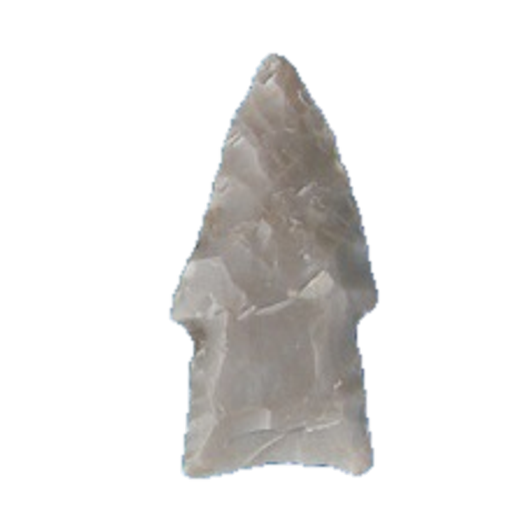
Arrowhead type
Darl Stemmed Point
Darl Stemmed2,500 - 1,300 B.P.Transitional Archaic27 reference photos
Key facts
- Age
- 2,500 - 1,300 B.P.
- Cultural period
- Transitional Archaic
- Size
- Medium to Large
- Shape
- Expanding Stem to Straight Stem
- Glacial period
- Roman Warm to Vandal Minimum
More from the Archaic period
Description
This triangular point exhibits a distinctive morphology, characterized by a narrow, medium-sized blade with an elliptical cross-sectional profile. The blade's longitudinal outline is marked by a subtle excurvate to straight curvature, lending it a slender appearance. A notable feature of this point is the frequent presence of a steeply beveled right edge on both faces, often accompanied by fine serrations on both beveled and non-beveled specimens. Additionally, many examples display right-hand beveling on one edge of each face. The shoulders of this point demonstrate variability, ranging from subdued to pronounced, and may be oriented horizontally or at an upward angle, with rare instances of slight barbing. The stem, which can be straight or slightly expanding, typically features beveling but lacks evidence of grinding or smoothing in the basal or hafting region. The base of the point is most commonly convex, although it may also be straight. The flaking pattern observed on this point is random, lacking a consistent or organized arrangement.
Size
The arrowheads exhibit a range of dimensions, with lengths spanning 25 to 70 mm, and an average length of 50 mm. The stem, which constitutes between 1/6 and 1/2 of the overall length, measures between 12 and 22 mm. In terms of width, these artifacts typically range from 10 to 15 mm.
Distribution
This style is mainly located in the heart of Texas and extends into the southern Pecos area and eastward towards the Coastal Plains. This style can also be discovered in western Louisiana, albeit less often. Bell (1958) situates this type in the central and western parts of Oklahoma.
Also found, less often, in
Additional information
In the realm of Native American arrowhead studies, the Darl point has garnered significant attention for its distinctive characteristics and potential variants. According to Story (1990), the Kent and Woden points can be considered as variants of the Darl point, highlighting the complexities of point typology. Further classification was proposed by Elton Prewitt (1981), who subdivided the Darl point into two distinct sub-types: the Mahomet and the Zephyr. For a more in-depth examination of these sub-types, a review of the Zephyr page is recommended.
Notably, the Darl point exhibits a beveled blade, a feature that distinguishes it from the Yarbrough point, which lacks this characteristic. Conversely, the Yarbrough point displays hafting region smoothing, a trait not observed in the Darl point (Bell, 1958). This distinction underscores the importance of meticulous analysis in identifying and categorizing arrowhead types. Moreover, Dwain Rogers (personal communication) has observed that Darl points are frequently found in stratigraphic layers immediately below those containing arrow-type points, suggesting that these points may have been among the last darts used in the region prior to the transition to arrow technology.
The study of the Darl point and its variants offers valuable insights into the technological and cultural developments of Native American communities. By examining the morphological characteristics and stratigraphic contexts of these points, researchers can reconstruct the historical narrative of dart and arrow usage in the region. The Darl point, with its beveled blade and lack of hafting region smoothing, represents a significant artifact in this narrative, providing a window into the lives and traditions of the people who crafted and utilized these tools. As such, continued research and analysis of the Darl point and its variants are essential for deepening our understanding of Native American archaeology and the evolution of projectile technology.
Identified by
- Year
- 1952
- Type site
- Belton Reservoir, Coryell County, Texas
Similar types
Types that are easy to confuse with the Darl Stemmed point.
Other types in this cluster
- Darl Blade
- Mahomet