
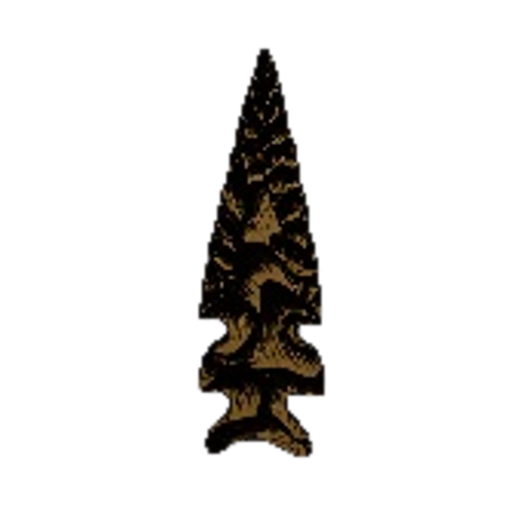
Arrowhead type
Bokoshe Point
Bokoshe800 - 600 B.P.Mississippian4 reference photos
Key facts
- Age
- 800 - 600 B.P.
- Cultural period
- Mississippian
- Culture
- Caddoan Culture
- Size
- Small
- Shape
- Expanding Stem to Side Notch to Other
- Glacial period
- Medieval Warm
More from the Mississippian period
Description
This corner-notched projectile point exhibits a distinctive morphology, characterized by a flattened cross-sectional profile. The blade itself is predominantly straight, featuring delicate serrations along its edge. A notable notch is situated approximately midway along the blade's length. The shoulders of the point display variability, ranging from a horizontal orientation to a subtle, barbed configuration. The stem expands in width and often presents a drooping ear-like morphology. The basal portion of the point is marked by a deep concavity, frequently assuming a V-shaped silhouette. The flaking pattern observed on this point is random, lacking a discernible, organized arrangement.
Size
Small
Distribution
This type is mainly discovered in the Spiro Mound area of eastern Oklahoma and western Arkansas
Additional information
In the realm of Native American arrowheads, a particular type has garnered attention for its potential affiliation with the Sallisaw type point. Notably, researcher Bryant (1992) has proposed that this type may constitute a socio-technic variant of the Sallisaw type, distinguished by its possible use in specialized contexts. Specifically, Bryant suggests that this variant may have been intentionally crafted for, or utilized in, ceremonial and burial settings, underscoring the complex and nuanced role of arrowheads in the cultural and spiritual practices of Native American communities.
The Sallisaw type point, in general, is a significant artifact that offers valuable insights into the technological and social developments of Native American groups. By examining the characteristics and potential uses of this socio-technic variant, researchers can gain a deeper understanding of the cultural significance and symbolic meaning attributed to these artifacts. The fact that this variant may have been reserved for ceremonial and burial purposes highlights the importance of considering the broader cultural context in which these arrowheads were created and used.
The identification of this socio-technic variant as a potential subset of the Sallisaw type point underscores the complexity and diversity of Native American material culture. As archaeologists continue to study and interpret these artifacts, they are reminded of the need to approach these objects with a nuanced understanding of their cultural significance and the various contexts in which they were used. By doing so, researchers can work to reconstruct a more comprehensive picture of the lives and practices of Native American communities, and the ways in which artifacts like arrowheads played a role in shaping their cultural and spiritual identities.
Identified by
- Named by
- James A. Brown
- Year
- 1976
- Type site
- Spiro Mound, Oklahoma
Similar types
Types that are easy to confuse with the Bokoshe point.