
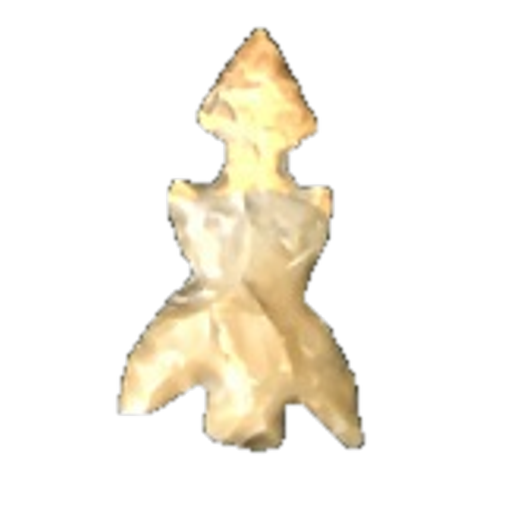
Arrowhead type
Chocoville Point
Chocoville900 - 600 B.P.Mississippian2 reference photos
Key facts
- Age
- 900 - 600 B.P.
- Cultural period
- Mississippian
- Culture
- Caddo culture
- Size
- Small to Medium
- Shape
- Straight Stem to Contracting Stem to Other
- Glacial period
- Medieval Warm
More from the Mississippian period
Description
This triangular point exhibits a compact to moderate size, characterized by a robust, oval-shaped cross-sectional profile. The blade's longitudinal profile is predominantly straight, occasionally curving outward in an excurvate manner, and may feature serrations along its edge. The shoulders of the point are typically barbed, although they can also be oriented horizontally. The stem's morphology varies, ranging from a straight configuration to one that expands or contracts slightly, terminating in a convex base. Notably, the base lacks any evidence of grinding. The flaking pattern on this point displays a range of techniques, from random, unpatterned removals to a more organized, collateral approach.
Size
The dimensions of the arrowheads are characterized by a total length ranging from 22 to 31 mm, with a mean length of 25 mm. The width spans from 12 to 18 mm, while the thickness measures between 0.3 and 0.4 mm, as per the standards outlined by Seivert and Rogers (2011).
Distribution
The complete range of this type remains unclear because of the scarce availability of confirmed specimens. This type is discovered at the Spiro Mounds in Oklahoma
Additional information
In his 1996 study, Brown proposed that a particular variant of arrowhead may be classified as a socio-technic variation of the Ashley type. Notably, this type is thought to have been utilized in ritualistic contexts, such as burials and ceremonies, highlighting its potential cultural significance. The characteristics of this variant bear a resemblance to those of the Duran type, with distinct differences in size and morphology. Specifically, this type is smaller in scale and features a single notch on both sides of the point, distinguishing it from other types. Interestingly, these arrowheads are often found in association with Ashley type points, suggesting a possible connection between the two types in terms of their use or cultural context.
The similarity between this socio-technic variant and the Duran type is intriguing, as it may indicate a degree of cultural exchange or technological convergence between different Native American groups. The single notch on both sides of the point is a notable characteristic, as it may have served a specific functional or symbolic purpose. Further research is needed to fully understand the significance of this variant and its relationship to other arrowhead types.
The discovery of these arrowheads in burial and ceremonial contexts provides valuable insights into the cultural practices and beliefs of Native American communities. The fact that they are often found alongside Ashley type points suggests a possible overlap in their use or cultural significance, highlighting the complexity and diversity of Native American material culture. As archaeologists continue to study these artifacts, they may uncover new information about the technological, social, and cultural dynamics of Native American societies, ultimately enriching our understanding of their history and cultural heritage.
Identified by
- Named by
- James A. Brown
- Year
- 1971
- Type site
- Spiro Mound, Oklahoma
Similar types
Types that are easy to confuse with the Chocoville point.
Other types in this cluster
- Ashley