
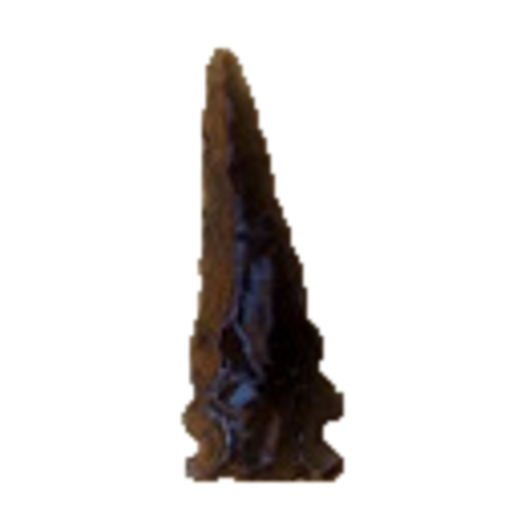
Arrowhead type
Dry Prong Multiple Notch Point
Dry Prong Multiple NotchChaco Cluster1,000 - 850 B.P.Developmental to Prehistoric2 reference photos
Key facts
- Age
- 1,000 - 850 B.P.
- Cultural period
- Developmental to Prehistoric
- Size
- Small
- Shape
- Side Notch
- Glacial period
- Medieval Warm
More from the Developmental period
Description
This triangular side notch point exhibits a distinctive morphology, characterized by an elliptical to flattened cross-sectional profile. The blade's curvature can range from excurvate to straight, presenting a varied silhouette. Notches are typically situated above the shoulder on one of the blade's edges, while parallel notches intersect the blade above the base, forming a horizontal shoulder that delineates an expanded stem. The basal edge of the point can be straight, concave, or notched, displaying a range of configurations. The flaking pattern on this point is random, lacking a discernible order or orientation, and is consistent with a technique that prioritizes functional utility over formal symmetry.
Size
The dimensions of the arrowheads are characterized by the following measurements: overall length ranges from 8 to 26 mm, with a mean length of 18 to 20 mm. The stem measures between 2 to 7 mm in length. The blade width varies from 7 to 13 mm, while the neck width spans 5 to 8 mm, with a notch depth of 1 to 2 mm. The width of the stem is between 5 to 15 mm, and the thickness of the arrowhead ranges from 3 to 6 mm.
Distribution
This type is mainly located in southeastern Arizona and extends into northwestern New Mexico
Mainly found in
Additional information
More information needed.
Identified by
- Named by
- Alan P. Olsen
- Year
- 1960
- Type site
- Dry Prong Site, Point of the Pines, Arizona
Similar types
Types that are easy to confuse with the Dry Prong Multiple Notch point.
- Desert
- Mimbre
- Pueblo Side Notch
- Sacaton
- Temporal