
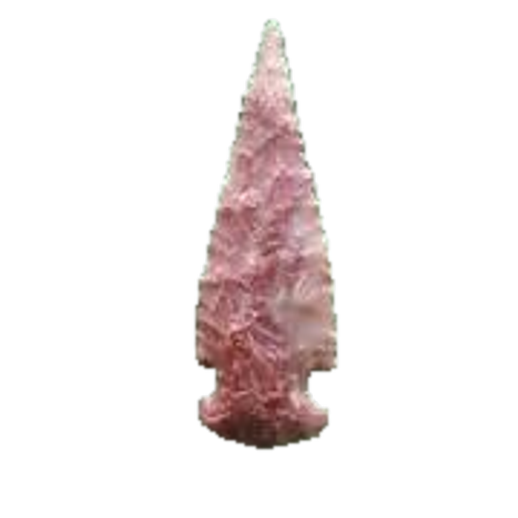
Arrowhead type
Bonito Point
BonitoChaco Cluster1.000 - 800 B.P.Developmental5 reference photos
Key facts
- Age
- 1.000 - 800 B.P.
- Cultural period
- Developmental
- Culture
- Pueblo Culture
- Size
- Small
- Shape
- Side Notch
- Glacial period
- Medieval Warm
More from the Developmental period
Description
This triangular side notch point exhibits a distinctive morphology, characterized by an elliptical to flattened profile. The blade's curvature is predominantly excurvate, with some specimens featuring one or more notches situated just above the shoulder, on one edge of the blade. Notches are typically U-shaped and parallel, entering the blade at either a horizontal or oblique orientation. The shoulders are generally oriented horizontally, although a slight upward inclination is not uncommon. The stem is notably expanded, while the base is most frequently convex, although a straight base is also observed in some instances. The flaking pattern on this point is random, lacking a discernible order or sequence.
Size
The dimensions of the arrowheads are as follows: they range in overall length from 19 to 45 mm, with a typical length of 21 to 26 mm. The stem measures between 5 to 7 mm in length. The blade width varies from 8 to 14 mm, averaging between 11 to 13 mm. The neck width is between 4 to 7 mm, while the stem width ranges from 8 to 15 mm. In terms of thickness, the arrowheads measure between 2 to 4 mm.
Distribution
This type is mainly discovered in the Chaco Canyon locality. Such specimens are located in territories linked to the Mogollon and Mimbres cultures. These specimens may occur in the lower Rio Grande locality with reduced regularity. These specimens may extend into the Dolores River Valley and into the Salt River and Gila River Valleys
Mainly found in
Additional information
According to Justice's 2002 research, the evolution of a specific arrowhead type can be directly linked to the Chaco Corner Notch type. Notably, these newly developed points emerged slightly later than their Chaco counterparts, yet they coexisted for a period at Pueblo Bonito. Archaeological findings have revealed that both types were utilized concurrently, as evidenced by their discovery in the same quiver and in caches together. This overlap highlights a transitional phase in the design of these arrowheads. A key characteristic of this evolution is the shift from a wider preform to a narrower one, accompanied by a change in notch placement. Specifically, the notches migrated from the corners to a higher position on the blade of the preform, distinguishing these points from their Chaco predecessors.
The simultaneous use of both point types at Pueblo Bonito offers valuable insights into the technological and cultural developments of the time. The fact that they were found together in quivers and caches suggests a period of experimentation or coexistence, where both designs were deemed effective for their intended purposes. This phenomenon provides a unique window into the lives of the people who crafted and utilized these arrowheads, showcasing their adaptability and innovative spirit. By examining the modifications in preform shape and notch placement, researchers can gain a deeper understanding of the factors driving these changes, whether they be functional, cultural, or environmental.
The transformation from the Chaco Corner Notch type to its successor represents a significant milestone in the development of Native American arrowhead technology. As Justice's research indicates, this evolution was characterized by a deliberate shift in design, reflecting the ingenuity and resourcefulness of the people who created these points. By analyzing these changes, archaeologists can reconstruct the historical context in which they occurred, shedding light on the complex interplay between technological innovation, cultural exchange, and environmental factors that shaped the lives of ancient Native American communities.
Identified by
- Named by
- Neil Judd
- Year
- 1954
- Type site
- Pueblo Bonito in Chaco Canyon, New Mexico
Similar types
Types that are easy to confuse with the Bonito point.
- Convento
- Dolores Expanding Stem
- Desert
- Dry Prong
- Rose Spring