
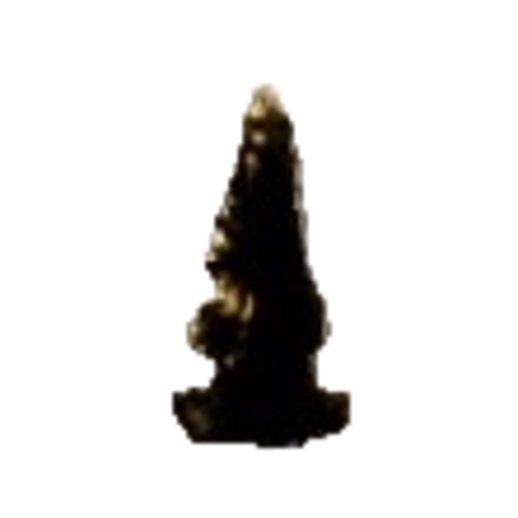
Arrowhead type
Temporal Point
TemporalChaco Cluster1,100 - 800 B.P.DevelopmentalKey facts
- Age
- 1,100 - 800 B.P.
- Cultural period
- Developmental
- Culture
- Pueblo Culture
- Size
- Small
- Shape
- Side Notch
- Glacial period
- Medieval Warm
More from the Developmental period
Description
This diminutive, triangular point features a side notch configuration, characterized by an elliptical to flattened profile. The blade's curvature exhibits variability, ranging from a pronounced excurvate shape to a straight alignment. Notches, typically singular or multiple, are situated above the shoulder on one of the blade's surfaces. A distinctive horizontal shoulder is formed by parallel notches that intersect the blade just above the base, giving rise to an expanded stem. The basal edge is marked by a convex curvature. The flaking pattern observed on this point is random, lacking a discernible, organized arrangement.
Size
The dimensions of the arrowheads are characterized by the following measurements: overall length ranges from 8 to 26 mm, with a mean length of 18 to 20 mm. The stem measures between 2 to 7 mm in length. The blade width varies from 7 to 13 mm, while the neck width spans 5 to 8 mm, with a notch depth of 1 to 2 mm. The stem width ranges from 5 to 15 mm, and the thickness of the arrowhead is between 3 to 6 mm.
Distribution
This type is mainly discovered from Springville, Arizona, extending into the Las Cruces and Tularosa areas of New Mexico, and below the El Paso region of Texas. It is also located in Chihuahua and Sonora, Mexico
Mainly found in
Additional information
In the realm of Native American arrowhead typology, a specific category of points has been identified, characterized by their fabrication from flakes using the pressure flaking technique, as noted by Justice in 2002. This particular type bears a strong resemblance to the Dry Prong type, with the two sharing many similarities in terms of their overall morphology. However, a key distinguishing feature between the two types lies in the shape of their bases.
A notable characteristic of the Dry Prong type is its base, which can range from straight to concave and often features notching. In contrast, the Temporal type is distinguished by its convex base, setting it apart from its Dry Prong counterpart. This subtle yet significant difference highlights the importance of meticulous observation and analysis in the classification and identification of arrowhead types. By examining the base shape and other diagnostic features, archaeologists can accurately categorize these points and gain a deeper understanding of the technological and cultural contexts in which they were created.
The similarity between the Temporal and Dry Prong types underscores the complexity and nuance of Native American arrowhead typology, where small variations in form and manufacture can hold significant meaning. As researchers continue to study and refine our understanding of these artifacts, the distinction between types like the Temporal and Dry Prong serves as a reminder of the importance of precise classification and the insights it can offer into the lives and traditions of Native American communities.
Identified by
- Named by
- Alan P. Olsen
- Year
- 1972
- Type site
- Temporal Site, Tularosa, New Mexico
Similar types
Types that are easy to confuse with the Temporal point.
- Convento
- Desert
- Dry Prong
- Rose Spring
- Sacaton