
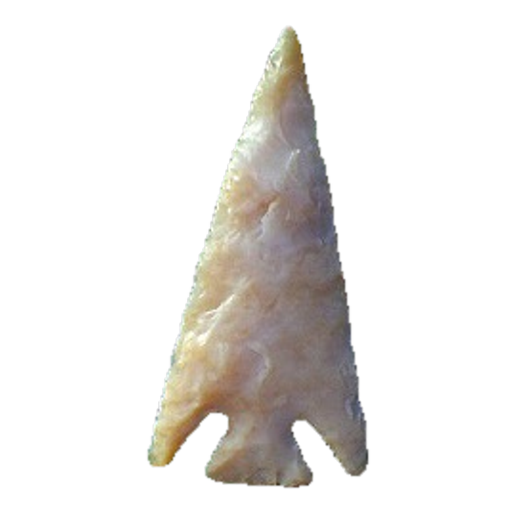
Arrowhead type
Chaco Point
ChacoChaco Cluster1,250 - 1,050 B.P.Developmental6 reference photos
Key facts
- Age
- 1,250 - 1,050 B.P.
- Cultural period
- Developmental
- Culture
- Pueblo Culture
- Size
- Small
- Shape
- Corner Notch to Side Notch
- Glacial period
- Vandal Minimum to Medieval
More from the Developmental period
Description
This triangular corner-notched point exhibits a slender profile with a cross-sectional morphology that is distinctly flattened. The blade's longitudinal curvature can range from straight to excurvate, presenting a varied silhouette. The diagnostic notches, which originate from the point's corners, penetrate the blade at a deep diagonal angle, creating pronounced shoulders that are accentuated by a narrow, constricted neck. These notches may maintain a linear trajectory or exhibit an upward curvature as they approach the point's apex. The stem expands outward, terminating in a base that is typically convex, although some specimens display a straight base. The flaking pattern observed on this point is characterized by a random, non-directional arrangement of flake scars.
Size
The arrowhead's dimensions are characterized by the following measurements: its overall length ranges from 15 to 45 mm, while the stem measures between 5 to 8 mm in length. The blade's width spans from 12 to 19 mm, and the neck width varies from 4 to 7 mm. The basal width is between 12 to 17 mm, and the thickness of the arrowhead is measured at 2 to 4 mm.
Distribution
This type is mainly located in the Chaco Canyon territory. Specimens are discovered in locales linked to the Mogollon and Mimbres cultures. Occurrences may extend into the lower Rio Grande region, albeit less often. These types may also appear in the Dolores River Valley and the valleys of the Salt and Gila Rivers
Mainly found in
Additional information
In archaeological contexts, the presence of certain projectile points can provide valuable insights into the temporal dynamics of a site. Notably, the co-occurrence of specific point types, such as Bonito points, can be observed. A key observation is that these points tend to be associated with older occupational layers, whereas Bonito points are more commonly found in newer, more recent layers of occupation. This pattern, as noted by Justice in 2002, suggests a potential chronological distinction between the two point types, with the former being characteristic of earlier periods and the latter of more recent ones. This distinction highlights the importance of careful stratigraphic analysis in understanding the cultural and temporal complexities of a site.
Identified by
- Named by
- Noel Justice
- Year
- 2002
- Type site
- Chaco Canyon, New Mexico
Similar types
Types that are easy to confuse with the Chaco point.
- Convento
- Dolores Expanding Stem
- Rose Spring