
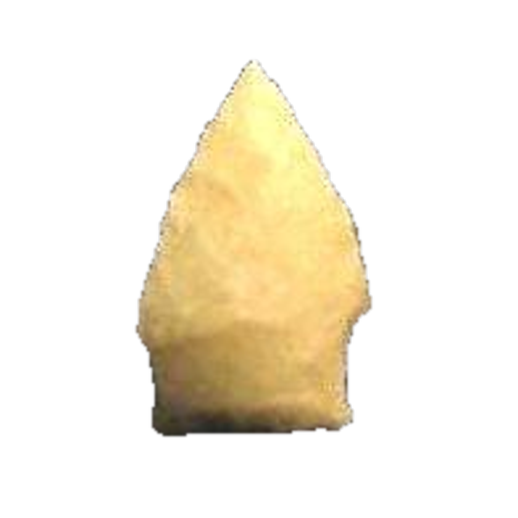
Arrowhead type
Elam Point
Elam3,000 - 2,000 B.P.Late Archaic to Transitional Archaic2 reference photos
Key facts
- Age
- 3,000 - 2,000 B.P.
- Cultural period
- Late Archaic to Transitional Archaic
- Size
- Small
- Shape
- Straight Stem
- Glacial period
- Neoglacial to Roman Warm
More from the Archaic period
Description
This triangular point features a compact, stemmed design with an elliptical profile. The blade edge exhibits a predominantly straight alignment, although occasional specimens may display a subtle excurvate curvature. The shoulder regions are either faintly defined or entirely absent, positioned at an upward inclination. The stem, which comprises approximately one-half to one-third of the point's overall length, is characterized by a straight to slightly flared morphology. The basal edge is variable, ranging from a straight to a convex configuration. Notably, the stem margins often exhibit evidence of edge smoothing, whereas the basal edge remains unsmoothed. The flaking pattern observed on this point is random, lacking a discernible arrangement.
Size
The dimensions of the arrowheads are characterized by a length range of 20 to 36 mm. The stem, which constitutes approximately half or more of the overall length, measures between 10 to 18 mm. In terms of width, the arrowheads span 25 to 30 mm.
Distribution
This type is mainly concentrated in the East Fork and Trinity River valleys, with decreased occurrence in other designated areas.
Additional information
In their 1954 publication, Suhm and Krieger raised an important question regarding the distinctiveness of Dallas points in relation to Elam points, sparking a debate about the validity of categorizing Dallas Stemmed as a separate type. Upon examining specimens from the University of Texas, the researchers observed a significant overlap in characteristics between the two types, leading them to suggest that the differences may not be substantial enough to warrant a separate classification. Notably, their analysis revealed no distinctive features that could reliably distinguish Dallas points from Elam points, implying that the primary difference lies in their geographic distribution rather than morphological characteristics. This finding highlights the complexities of arrowhead typology and the need for careful consideration of regional variations in the classification of Native American projectile points.
Identified by
- Named by
- William W. Cook and R. K. Harris
- Year
- 1952
Similar types
Types that are easy to confuse with the Elam point.