
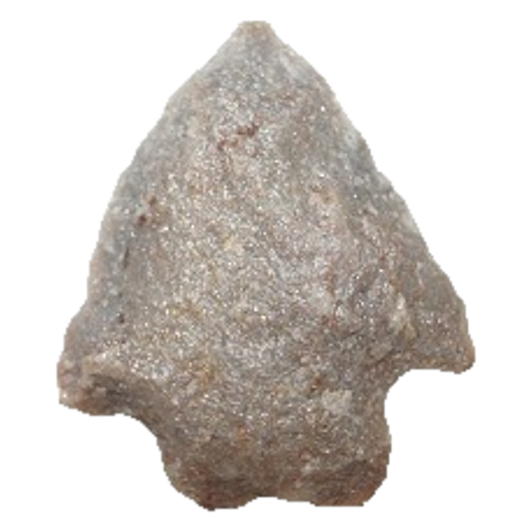
Arrowhead type
Culpepper Point
Culpepper8,000 - 7,000 B.P.Early Archaic3 reference photos
Key facts
- Age
- 8,000 - 7,000 B.P.
- Cultural period
- Early Archaic
- Size
- Medium
- Shape
- Expanding Stem to Bifurcated
- Material
- Quartz
- Glacial period
- Middle Holocene
More from the Archaic period
Description
This medium-sized, triangular point exhibits a distinctive bifurcated form, characterized by an elliptical cross-sectional profile. The blade itself is excurvate, curving outward in a subtle, sweeping motion. The shoulders of the point are often mismatched, with one displaying a slight barb, while the other ranges from a horizontal orientation to a gentle, upward inclination. The notches that define the stem are formed by flakes that originate from the corner of the preform, resulting in an expanding stem. The basal corners are smoothed into rounded protrusions, resembling ears or lobes, which frame the concave base. This concavity creates the point's signature bifurcated appearance, with the overall flaking pattern appearing random and unstructured.
Size
The dimensions of the arrowheads are characterized by the following measurements: overall length ranges from 35 to 60 mm, with a typical average span of 40 to 50 mm. The stem segment measures between 9 to 15 mm in length, while the blade itself spans a width of 20 to 40 mm. Additionally, the stem width is observed to be between 15 to 26 mm.
Distribution
This specimen is mainly discovered in the Piedmont regions of Virginia and North Carolina.
Mainly found in
Also found, less often, in
Additional information
More information needed.
Identified by
- Named by
- William J. Hranicky
- Year
- 1988
Similar types
Types that are easy to confuse with the Culpepper point.
- Kanawha
- Kirk Serrated
- LeCroy
- Rice Lobed
- Southampton