
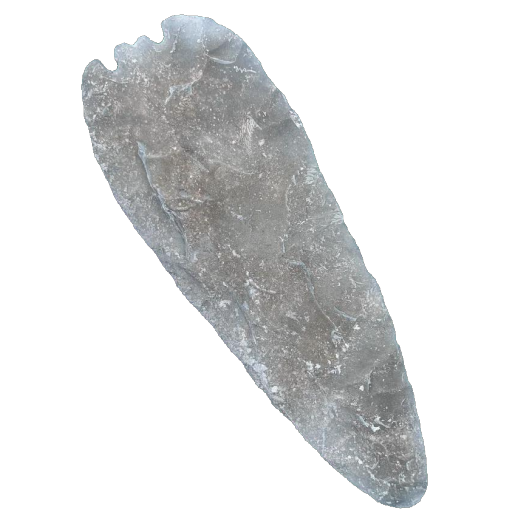
Arrowhead type
Base Tang Knife
Base Tang Knife4,000 - 2,000 B.P.Middle Archaic to Late Archaic13 reference photos
Key facts
- Age
- 4,000 - 2,000 B.P.
- Cultural period
- Middle Archaic to Late Archaic
- Size
- Medium to Large
- Shape
- Basal Notch
- Glacial period
- Neoglacial to Roman Warm
More from the Archaic period
Description
This knife exhibits a distinctive morphology, characterized by a medium to large size and a triangular to ovoid shape, with a cross-sectional profile that is notably flattened. The blade itself is marked by a broad, outwardly curved (excurvate) shape, often displaying asymmetry. The base of the knife features small notches that create barbed shoulders, which merge into a stem that can range from straight to expanding in form. The basal edge varies between a convex and straight configuration. The flaking pattern observed on this artifact is random, lacking a discernible order or sequence.
Size
The arrowhead's dimensions are characterized by a total length ranging from 70 to 130 mm, with the stem section measuring between 3 to 13 mm in length. The blade itself spans a width of 35 to 80 mm, while the stem's width is between 10 to 25 mm.
Distribution
This type is mainly located in the heart of Texas.
Mainly found in
Also found, less often, in
Additional information
More information needed.
Identified by
- Named by
- J. T Patterson
- Year
- 1936
Similar types
Types that are easy to confuse with the Base Tang Knife point.
- Corner Tang Knife
- Mid Back Tang Knife
- San Saba