
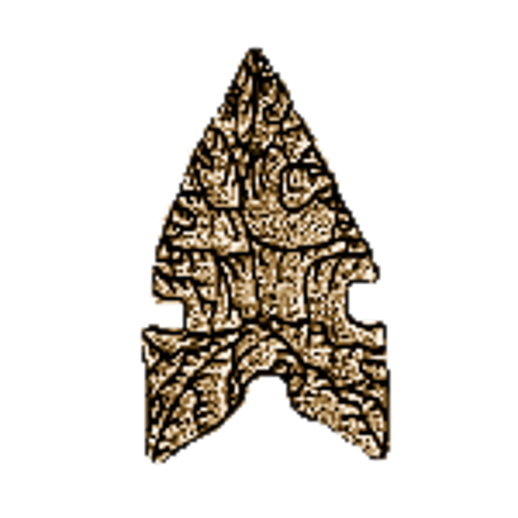
Arrowhead type
Abiquiu Point
Abiquiu4,800 - 2,500 B.PLate Archaic4 reference photos
Key facts
- Age
- 4,800 - 2,500 B.P
- Cultural period
- Late Archaic
- Size
- Medium
- Shape
- Side Notch
- Material
- Chert
- Glacial period
- Neoglacial
More from the Archaic period
Description
This triangular side-notched projectile point exhibits a medium-thin profile with a cross-section that has been deliberately flattened. The blade's curvature can vary, ranging from straight to incurvate, and is characterized by the presence of small, narrow parallel notches that intersect the blade at a high point, oriented along a horizontal axis. The shoulders of the point are horizontally aligned and give way to an expanded stem. Notably, the basal area of this point is quite large. The base itself can display a range of morphologies, from a slight concavity to a more pronounced, deep concave notch or a distinctive V-shaped configuration. The flaking pattern observed on this point is random, lacking a discernible order or sequence.
Size
The dimensions of the arrowheads are as follows: they range in overall length from 26 to 41 mm, with stem lengths varying between 11 and 16 mm. The width of the blade spans 13 to 19 mm, while the neck width measures between 8 and 15 mm. The basal width falls within the range of 15 to 22 mm, and the thickness is recorded as 3 to 5 mm, according to the standards outlined by Thoms (1977).
Distribution
This type is mainly discovered in the southwestern intersection area.
Mainly found in
Additional information
In the realm of Native American archaeology, the Abiquiu point type holds significant interest, with its name derived from the Tewa Pueblo language. The term "Abiquiu" is multifaceted, with various interpretations proposed, including the "hooting of an owl," "ruins," "chokecherry," and "timber end place." This Corner Notch point type was initially identified by anthropologist Alston V. Thomas, who provisionally named it based on specimens found at the Abiquiu Tewa Pueblo, located in Rio Arriba County, New Mexico.
The Abiquiu point type is a notable example of the diverse projectile point typology found in the Northern Rio Grande region of New Mexico. Thomas's work, as presented in his 1977 unpublished master's thesis, "A preliminary projectile point typology for the Northern Rio Grande region New Mexico," provides valuable insights into the characteristics and distribution of this point type. Although the thesis, completed at the Department of Anthropology, Texas Tech University, does not include additional information or example images, it serves as a foundational resource for understanding the Abiquiu point type within the context of the region's archaeological record.
Further study of the Abiquiu point type can offer a deeper understanding of the cultural and technological developments of the Tewa Pueblo people, as well as the broader archaeological landscape of the Northern Rio Grande region. The varied interpretations of the term "Abiquiu" itself highlight the complexities and nuances of Native American languages and cultures, underscoring the importance of continued research and collaboration with indigenous communities to uncover the rich history and significance of these artifacts.
Identified by
- Named by
- Alston V. Thoms
- Year
- 1977
Similar types
Types that are easy to confuse with the Abiquiu point.
- Chiricahua
- Point of the Pines
- Pueblo
- San Rafael
- Ventana