
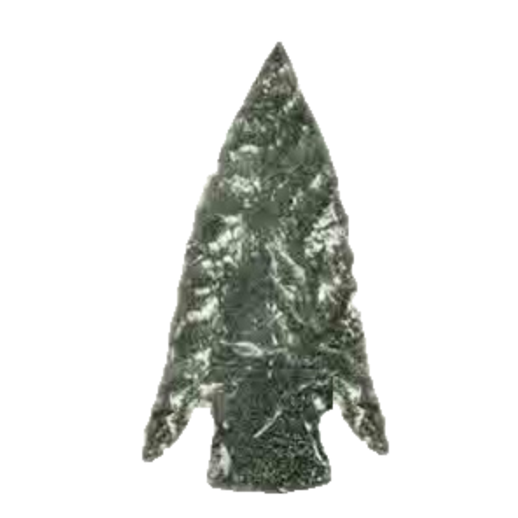
Arrowhead type
Bella Vista Point
Bella Vista2,000 - 1650 d.n.e.Primer Period2 reference photos
Key facts
- Age
- 2,000 - 1650 d.n.e.
- Cultural period
- Primer Period
- Size
- Medium to Large
- Shape
- Basal Notch to Corner Notch
- Glacial period
- Roman Warm
Description
This distinctive projectile point exhibits a triangular form with a basal notch, characterized by a slender, elliptical profile. The blade's curvature is subtly outward, terminating in a sharp, tapering tip reminiscent of a needle. The notches, which originate from the base of the preform, create a pronounced, barbed shoulder that extends downward to the point's base. The stem, which expands slightly, is marked by a basal edge that ranges from nearly straight to distinctly convex. Notable for its exceptional craftsmanship, this point features a random flaking pattern, indicative of a high level of technical skill.
Size
The arrowhead's dimensions are as follows: it ranges in length from 57 to 96 mm, with a stem length of 8 to 11 mm. The blade itself spans 30 to 46 mm in width, while the basal stem width measures between 17 to 22 mm. The neck of the arrowhead is 13 to 19 mm wide, and its overall thickness varies from 6 to 9 mm.
Distribution
This variety is documented in Cueva de la Nopalera, Hidalgo, Mexico. Such artifacts are believed to occur extensively across the Valley of Mexico.
Additional information
More information needed.
Identified by
- Named by
- Angel Garcia Cook
- Year
- 1967
- Type site
- Cueva de la Nopalera, Hidalgo
Similar types
Types that are easy to confuse with the Bella Vista point.
- Bulverde - Nopalera
- Castroville
- Marcos
- Nopalera
- Shincola
- Tecolate I
- Tepeapulco
- Xihuingo