
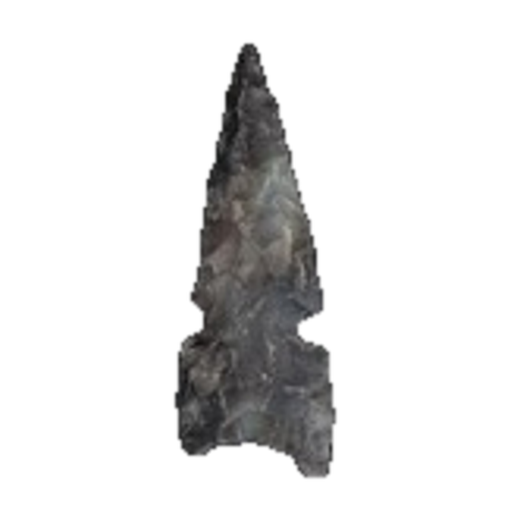
Arrowhead type
Buffalo Gap Single Spur Point
Buffalo Gap Single SpurPlains Side Notch Cluster550 - 350 B.P.Developmental to Late Prehistoric2 reference photos
Key facts
- Age
- 550 - 350 B.P.
- Cultural period
- Developmental to Late Prehistoric
- Size
- Small
- Shape
- Side Notch
- Glacial period
- Little Ice Age
More from the Late Prehistoric, Developmental periods
Description
This slender projectile point exhibits a side notch configuration, characterized by a narrow, flattened profile. The blade's longitudinal axis is predominantly straight, although subtle deviations may yield a faintly excurvate silhouette. A pair of parallel, U-shaped notches are discernible, where they intersect the blade, generating well-defined, horizontal shoulders that converge to form an expanded stem. The basal margin is marked by a gentle concavity, while the basal corners are sharply pointed, with one corner extending downward to form a distinctive spur-like protrusion. The flaking pattern observed on this point is random, lacking a discernible, organized sequence.
Size
The dimensions of the arrowheads are characterized by a length range of 10 to 34 millimeters, with a mean length of 20.6 millimeters. In terms of width, the measurements span from 9 to 18 millimeters, averaging 14.2 millimeters. The thickness of the arrowheads varies between 2 and 7 millimeters, with a mean thickness of 2.6 millimeters.
Distribution
This type is mainly discovered in the upper grasslands area of Montana, northern South Dakota, North Dakota, and extending into southern Saskatchewan
Mainly found in
Also found, less often, in
Additional information
In the realm of Native American arrowhead typology, a distinctive variant has been identified, characterized by a singular basal corner that extends downward to form a spur. This particular type bears a strong resemblance to the Washita Triangular, with the notable exception of this unique basal feature. As documented by Kehoe in 1966, this type is part of a broader category known as Plains Side Notch variants.
The Plains Side Notch category encompasses a range of subtypes, each with its own distinct characteristics. These subtypes include the primary Plains Side Notch, as well as several others, such as Billings, Buffalo Gap, Cut Bank, Emigrant, Paskapoo, Pekisko, and Washita. Kehoe's 1966 illustration provides a valuable visual reference for understanding the nuances of these variants. By examining these subtypes, researchers can gain insight into the technological and cultural developments of the Native American groups that crafted these arrowheads.
The study of these arrowhead variants offers a fascinating glimpse into the lives and traditions of the indigenous peoples who created them. The presence of a spur-like feature on the basal corner of this particular type, for example, may indicate a specific functional or ceremonial purpose. Further analysis of these artifacts can provide valuable information about the cultural associations and historical contexts in which they were used, shedding light on the complex and diverse world of Native American archaeology.
Identified by
- Named by
- Thomas Kehoe
- Year
- 1966
- Type site
- (click
Similar types
Types that are easy to confuse with the Buffalo Gap Single Spur point.
- Emigrant
- Lookingbill
- Pekisko
- Washita