
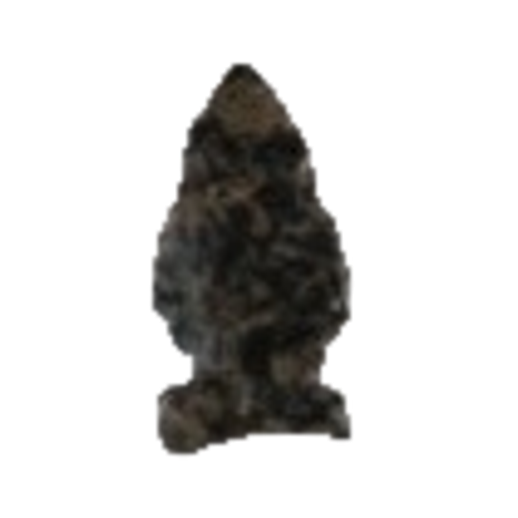
Arrowhead type
Cayley Point
Cayley1,250 - 650 B.P.Developmental to Classic2 reference photos
Key facts
- Age
- 1,250 - 650 B.P.
- Cultural period
- Developmental to Classic
- Culture
- Old Woman's Phase
- Size
- Small
- Shape
- Side Notch
- Glacial period
- Vandal Minimum to Little Ice Age
More from the Developmental, Preclassic and Classic periods
Description
This triangular side notch point exhibits a distinctive morphology, characterized by a compressed cross-sectional profile. The blade edge is largely linear, with a subtle curvature that is barely perceptible. The notching pattern is defined by parallel, U-shaped indentations that penetrate the lateral margins of the preform, creating a pronounced horizontal shoulder and an expanded stem of equivalent width to the shoulders. Notably, the stem often displays asymmetry. The basal margin varies in shape, ranging from a straight line to a gentle, concave curve. The flaking pattern on this point is characterized by a non-directional, random arrangement of scars.
Size
The dimensions of these arrowheads are characterized by the following measurements: they range in length from 10 to 46 mm, with a mean length of 20 mm. The blade width varies between 7 and 22 mm, averaging 12.5 mm. The base width spans from 0.3 to 19 mm, with an average of 12.6 mm. The neck width ranges from 0.7 to 14 mm, with a mean of 8.7 mm. Lastly, the thickness of these arrowheads measures between 1.4 and 7.4 mm, with an average thickness of 3.3 mm, as reported by Peck and Ives (2001).
Distribution
This type is linked to the Old Woman's Phase in Alberta, extending into Saskatchewan and Montana. These artifacts are mainly discovered in Alberta's southern region, southern Saskatchewan, and parts of Montana
Additional information
In the realm of archaeological research, a particular type of projectile point has garnered significant attention due to its distinctive characteristics. Notably, these points bear a striking resemblance to Prairie Side Notch points, making them virtually indistinguishable from one another. A key observation made by Peck in 2001 sheds light on the cultural affiliation of these points, suggesting that they can be used as diagnostic tools for identifying the Old Woman's Phase. This phase, marked by specific cultural and temporal attributes, is characterized by the presence of these distinctive projectile points, which have been found to be closely associated with the material culture of this period.
The Old Woman's Phase, as diagnosed by the presence of these points, provides valuable insights into the lives and traditions of the indigenous populations that created them. By examining the morphological characteristics of these points, researchers can gain a deeper understanding of the technological and cultural developments that occurred during this time. The fact that these points are indistinguishable from Prairie Side Notch points highlights the complexity and nuance of archaeological classification, underscoring the need for careful analysis and consideration of multiple factors when interpreting the material record.
The work of Peck (2001) has been instrumental in shaping our understanding of these projectile points and their role in defining the Old Woman's Phase. By recognizing the diagnostic potential of these points, archaeologists can refine their chronologies and cultural associations, ultimately contributing to a more comprehensive and accurate picture of the past. As research continues to uncover new evidence and refine our understanding of these enigmatic points, it is likely that our appreciation for the cultural and historical context in which they were created will only continue to grow.
Identified by
- Named by
- Trevor Peck
- Year
- 1996
Similar types
Types that are easy to confuse with the Cayley point.
- Athapaskan Side Notch
- Cut Bank
- Cluny
- Irvine
- Kamloops
- Nanton
- Paskapoo
- Pekisko
- Plains Side Notch
- Prairie Side Notch
- Stott
- Tompkins