
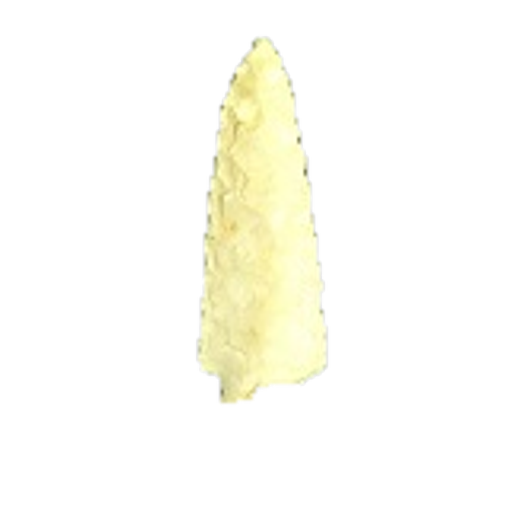
Arrowhead type
Billings Double Spur Point
Billings Double SpurPlains Side Notch Cluster300 - 200 B.P.Historic3 reference photos
Key facts
- Age
- 300 - 200 B.P.
- Cultural period
- Historic
- Size
- Small
- Shape
- Side Notch
- Glacial period
- Little Ice Age
More from the Historic period
Description
This triangular point exhibits a slender profile, characterized by a flattened cross-sectional shape and a predominantly straight blade edge, although some specimens may display a subtle outward curvature. The cutting edge often features delicate serrations, adding to the point's overall refinement. Notably, the parallel notches are positioned relatively low on the point, marked by narrow and deep incisions that are distinctly below the midpoint. The shoulders are defined by a horizontal orientation, merging with an expanded stem. The basal margin typically presents a squared edge, accompanied by a base that is either straight or slightly concave, frequently featuring a central basal notch. The flaking pattern on this point appears to be random, lacking a discernible order or sequence.
Size
The dimensions of the arrowheads are characterized by a length range of 10 to 34 millimeters, with a mean length of 20.6 millimeters. In terms of width, the measurements span from 9 to 18 millimeters, averaging 14.2 millimeters. The thickness of the arrowheads varies between 2 and 7 millimeters, with a mean thickness of 2.6 millimeters.
Distribution
This type is mainly discovered in middle to upper Montana and extending into North Dakota, Alberta, and Saskatchewan
Mainly found in
Additional information
In the realm of Native American arrowheads, the Desert Sierra type bears a striking resemblance to those found in the Great Basin and the Colorado Plateau. Notably, the geographic distribution of the Desert Sierra type stretches into Wyoming, although it does not extend into Montana. This particular type is characterized by its association with the Plains Side Notch variants, a classification system developed by Kehoe in 1966.
The Plains Side Notch variants are a diverse group, comprising eight distinct sub-types, each with its own unique characteristics. These sub-types include the Primary type, as well as the Billings, Buffalo Gap, Cut Bank, Emigrant, Paskapoo, Pekisko, and Washita types. Each of these variants offers valuable insights into the technological and cultural adaptations of the Native American groups that crafted them. By examining the morphology and distribution of these arrowheads, archaeologists can reconstruct the cultural and historical contexts in which they were created and used.
The study of these arrowhead types is significant, as it provides a window into the lives and traditions of the Native American communities that inhabited the Great Basin and Colorado Plateau regions. The Desert Sierra and Plains Side Notch variants are particularly notable for their presence in the archaeological record, spanning a significant geographic and temporal range. As such, they offer a unique opportunity for archaeologists to explore the complexities of Native American cultural expression and technological innovation, shedding light on the intricate relationships between human populations and their environments.
Identified by
- Named by
- Thomas Kehoe
- Year
- 1966
- Type site
- (click
Similar types
Types that are easy to confuse with the Billings Double Spur point.
- Desert Sierra
- Emigrant
- Harrell
- Mallory