
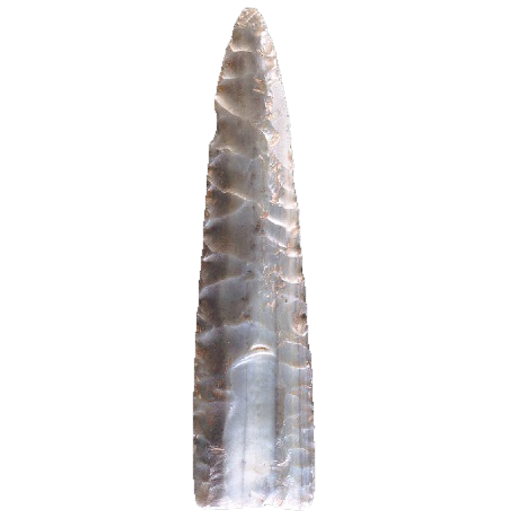
Arrowhead type
Anzick Clovis Point
Anzick ClovisClovis Cluster15,000 - 10,000 B.P.Paleo3 reference photos
Key facts
- Age
- 15,000 - 10,000 B.P.
- Cultural period
- Paleo
- Size
- Large
- Shape
- Lanceolate
- Glacial period
- Late Pleistocene
More from the Paleo period
Description
This sizable, triangular projectile point exhibits a distinctive elliptical profile. Its blade curvature is characterized by a pronounced excurvate shape, where the tip converges inward and the edges approach a parallel alignment. The basal edge is marked by a straight boundary, accompanied by rounded corners that soften its overall geometry. A relatively short flute is present, extending from the base in proportion to the blade's length. The flaking pattern on this point displays variability, ranging from random and multidirectional to more organized parallel or oblique arrangements.
Size
Large
Distribution
This type is mainly discovered in regions linked to Ancestral Puebloan locations. This type may be discovered on the Colorado Plateau in the southern Manti La Sal range and southward to the Su Site of New Mexico and westward to Navajo Mountain
Mainly found in
Also found, less often, in
Additional information
The Anzick Site in Montana is notable for its association with a distinct triangular, straight-base variant of the Clovis point. This particular type has garnered significant attention, with some researchers, like Perino, suggesting that its morphology is more akin to a knife than a traditional projectile point. Within the realm of Clovis point studies, this variant is frequently referenced in discussions specifically pertaining to the Anzick Site, highlighting its importance within the context of this archaeological locale. However, it is worth noting that professional references to this type are relatively scarce outside of the Anzick Site, with limited examples from other sites or regions.
The classification of Clovis-style points remains a topic of considerable debate among archaeologists. One perspective posits that the characteristic features of Clovis points exhibit a high degree of consistency across their distribution, with variations being attributed to normal fluctuations within the type. In contrast, others argue that specific regions developed specialized variants of the Clovis point, which are more frequently encountered in those areas. This latter viewpoint suggests that these regional variants may represent later adaptations or unique subtypes of the Clovis point, underscoring the complexity and diversity of Clovis point morphology.
The ongoing discussion surrounding Clovis point classification serves as a testament to the intricate and nuanced nature of Paleoindian archaeology. As researchers continue to refine our understanding of Clovis point variability, it is essential to consider the broader implications of these findings, including the potential for regional specialization and the evolution of point styles over time. By examining the characteristics of Clovis points, such as the triangular, straight-base variant associated with the Anzick Site, archaeologists can gain valuable insights into the technological, cultural, and environmental contexts of Paleoindian societies, ultimately enhancing our comprehension of the lives and traditions of these ancient cultures.
Identified by
- Named by
- Gregory Perino
- Year
- 1985
- Type site
- The Anzick Site (24PA504), Park County, Montana
Similar types
Types that are easy to confuse with the Anzick Clovis point.
- Clovis
- Clovis Colby
Other types in the Clovis Cluster
- Clovis Hazel
- Clovis St Louis
- Clovis Tulare
- Clovis Unfluted
- Debert
- Holcombe
- Redstone
- Ross County