
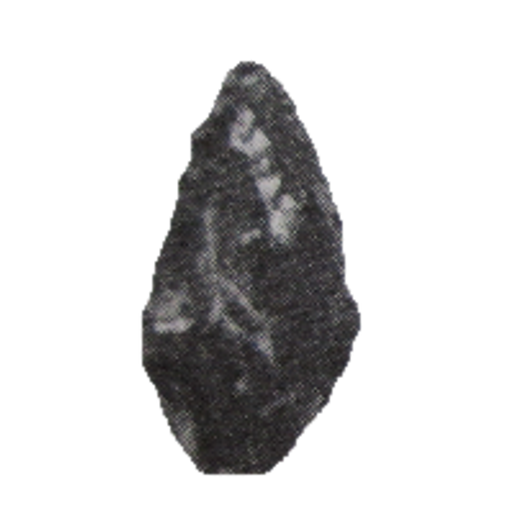
Arrowhead type
Adams Diamond Point
Adams Diamond1,700 - 900 B.P.Transitional Archaic to Preclassic2 reference photos
Key facts
- Age
- 1,700 - 900 B.P.
- Cultural period
- Transitional Archaic to Preclassic
- Culture
- Llano Grande culture
- Size
- Small to Medium
- Shape
- Contracting Stem to Ovoid
- Material
- Utilized
- Glacial period
- Roman Warm to Medieval Warm
More from the Archaic, Preclassic and Classic periods
Description
This triangular point exhibits a distinctive morphology, characterized by a contracting stem and an elliptical profile. The blade displays a pronounced excurvate curvature, with beveling evident on both edges of each face. The shoulders are variably defined, ranging from subtle to pronounced, and are positioned at an upward inclination. The stem tapers inward, featuring excurvate edges that converge at a narrow, straight base. The flaking pattern on this point is random, lacking a discernible order or sequence.
Size
The dimensions of these arrowheads are characterized by a length range of 33 to 47 millimeters, with a mean length of 41 millimeters. The blade width varies between 13 and 25 millimeters, averaging 21 millimeters. In terms of thickness, the measurements fall within a range of 6 to 8 millimeters, with an average thickness of 8 millimeters, as determined from a limited dataset.
Distribution
These artifacts are linked to the Llano Grande tradition of Sonora, Chihuahua, Sinloa, Nayarit, Jalisco, and Zacatecas.
Mainly found in
Additional information
In contrast to other notable projectile points, such as the San Miguel Diamond and the Trujillo Diamond, the Adams Diamond exhibits a distinctive morphology characterized by a longer and narrower blade. This unique characteristic was first observed by Spence in 1971, highlighting the Adams Diamond's singular profile within the context of Native American arrowhead typology. The elongated and slender shape of the Adams Diamond blade sets it apart from its counterparts, underscoring the diversity of designs and forms present in the archaeological record of Native American weaponry.
Identified by
- Named by
- Michael W. Spence
- Year
- 1971
Similar types
Types that are easy to confuse with the Adams Diamond point.
Other types in this cluster
- Innes