
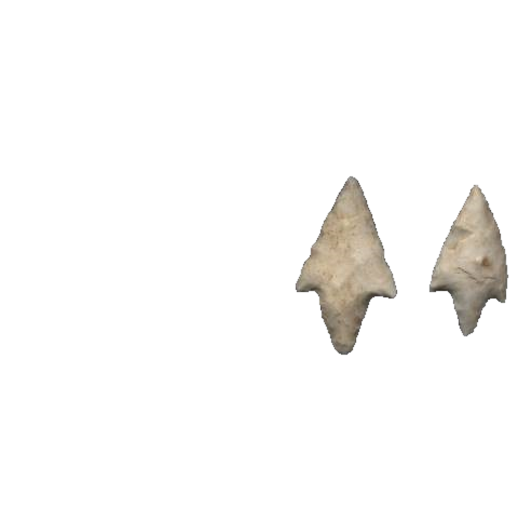
Arrowhead type
Acitita Point
Acitita3,000 -2,600 B.P.Transitional Archaic2 reference photos
Key facts
- Age
- 3,000 -2,600 B.P.
- Cultural period
- Transitional Archaic
- Size
- Small to Medium
- Shape
- Contracting Stem
- Glacial period
- Neoglacial
More from the Archaic period
Description
This triangular stemmed point exhibits a size range of 1.5 to 2.75 inches, characterized by a predominantly flattened cross-sectional profile, although some specimens may display an elliptical shape. The blade morphology is variable, spanning straight, incurvate, and recurvate forms, often marked by a curved tip and a shoulder that flares outward. Notable features include the presence of alternating beveling on many examples, while a smaller subset displays serrated blades. The shoulders are frequently asymmetrical, sometimes bearing a slight barb or angled upward. The stem's orientation ranges from straight to subtly expanding, and the base, which is often thinned, may be straight or slightly convex. The flaking pattern observed on this point is random.
Size
The dimensions of the arrowheads are characterized by the following measurements: overall length ranges from 31 to 91 mm, with a typical average length of 35 to 45 mm. The stem length varies between 10 to 20 mm, averaging 12 to 16 mm. The width of the blade spans 19 to 45 mm, with an average width of 22 to 32 mm. Additionally, the stem width at the shoulders measures between 9 to 22 mm.
Distribution
This type is mainly discovered in Mexico and extends into the Trans Pecos area of Texas and southern New Mexico.
Mainly found in
Additional information
In the realm of Native American archaeology, a distinctive type of arrowhead has been identified and named after its prevalent discovery in a specific geographic region. The Cedral point, as it has come to be known, owes its designation to its frequent presence in Mexico, where it was commonly unearthed. This eponymous naming convention reflects the strong cultural and spatial associations that archaeologists have established between the artifact and its place of origin. By examining the distribution and characteristics of the Cedral point, researchers can gain valuable insights into the technological, social, and economic dynamics of the indigenous cultures that crafted and utilized these arrowheads.
The Cedral point's namesake region in Mexico has yielded a significant number of these artifacts, facilitating a deeper understanding of their role in the material culture of Native American groups. Through meticulous analysis and comparison of the Cedral points found in this region, archaeologists can reconstruct aspects of the daily lives, subsistence strategies, and technological developments of these ancient societies. Furthermore, the study of the Cedral point contributes to a broader comprehension of the complex networks of exchange, migration, and cultural diffusion that existed among Native American communities in Mexico and beyond.
The identification and study of the Cedral point underscore the importance of regional archaeological contexts in illuminating the lives and traditions of Native American peoples. By focusing on the specific cultural and spatial associations of this arrowhead type, researchers can develop more nuanced and detailed accounts of the histories and experiences of these communities. As a result, the Cedral point has become an important artifact in the archaeological record, offering a unique window into the technological, social, and cultural practices of Native American groups in Mexico and contributing to a richer understanding of the region's rich cultural heritage.
Identified by
- Named by
- Walter W. Taylor
- Year
- 1966
Similar types
Types that are easy to confuse with the Acitita point.