
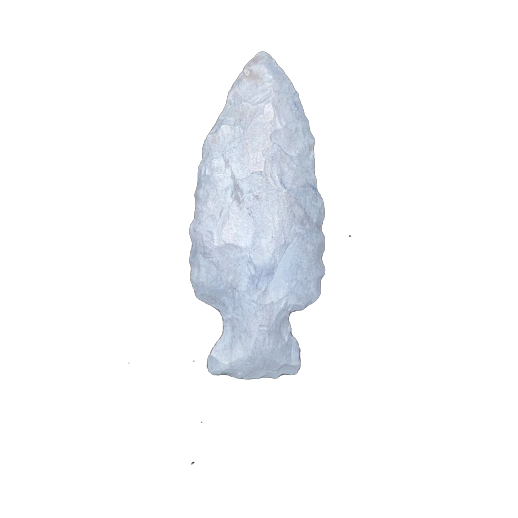
Arrowhead type
Ace of Spades Point
Ace of Spades4,000 - 3,000 B.P.Late Archaic6 reference photos
Key facts
- Age
- 4,000 - 3,000 B.P.
- Cultural period
- Late Archaic
- Size
- Medium to Large
- Shape
- Side Notch to Expanding Stem
- Material
- Chert
- Glacial period
- Neoglacial
More from the Archaic period
Description
This triangular point exhibits a distinctive morphology, characterized by a medium to large size and an elliptical profile. The blade's curvature is outward, with its maximum width occurring at the shoulder, which can range from a horizontal orientation to a slightly elevated angle. The stem tapers outward, terminating in a base that is typically convex, although it may occasionally be straight. Evidence of grinding is visible on the basal and hafting areas, indicating deliberate shaping for attachment. The flaking pattern on this point is characterized by a non-directional, random arrangement of flakes, lacking a discernible pattern or orientation.
Size
The arrowheads exhibit the following dimensional characteristics: overall length ranges from 45 to 73 mm, while the stem measures between 9 and 12 mm in length. The blade itself spans a width of 23 to 31 mm, with the neck narrowing to a width of 8 to 13 mm. At the base, the width varies from 10 to 19 mm.
Distribution
This type is mainly discovered in the Grand River basin of Ontario and extending into southernmost Ontario. This type has also been identified in Day County, Michigan
Additional information
In his 1980 study, Kenyon proposed a functional distinction between smaller and larger specimens of a particular arrowhead type. According to Kenyon, the smaller variants, which would be categorized as Innes type points, were likely utilized as projectile points, whereas their larger counterparts were probably employed as knives. This size-based dichotomy suggests a deliberate design choice, with the smaller Innes type points serving a specific purpose in the arsenal of Native American hunters.
Kenyon's research also revealed a technological continuum among several point types, including Ace of Spades, Crawford Knoll, Innes, and Hind. Rather than representing distinct, unique types, these point styles are believed to be variants of a single, overarching design. This interpretation implies that the differences between these point types are more a matter of degree than of kind, with each variant reflecting a subtle refinement or adaptation of the same fundamental technology. By recognizing this continuum, archaeologists can gain a deeper understanding of the evolutionary dynamics at play in the development of Native American lithic technology.
The notion that these point types represent a continuum rather than discrete categories has significant implications for our understanding of the cultural and historical contexts in which they were produced. By examining the subtle variations within this continuum, researchers can reconstruct the technological and social processes that shaped the development of Native American material culture. Furthermore, this perspective highlights the importance of considering the functional and technological aspects of arrowhead design, rather than relying solely on morphological characteristics to define distinct types. Ultimately, Kenyon's insights have contributed to a more nuanced and comprehensive understanding of the complexities of Native American lithic technology.
Identified by
- Named by
- Paul Lennox
- Year
- 1982
- Type site
- Innes Site
Similar types
Types that are easy to confuse with the Ace of Spades point.
Other types in this cluster
- Innes