
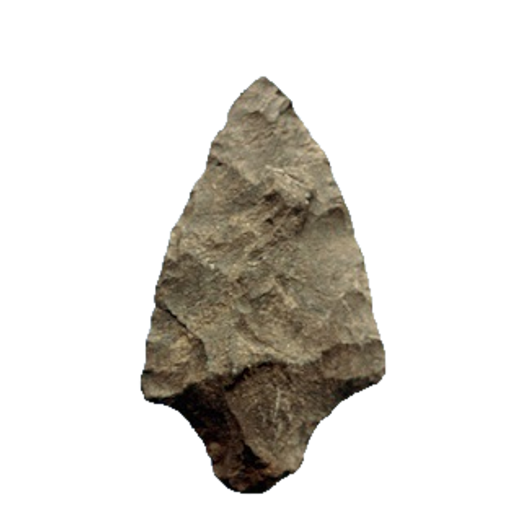
Arrowhead type
Snook Hill Point
Snook HillGenesee Cluster4,900 - 3,800 B.P.Middle Archaic12 reference photos
Key facts
- Age
- 4,900 - 3,800 B.P.
- Cultural period
- Middle Archaic
- Culture
- Satchell Complex
- Size
- Medium
- Shape
- Contracting Stem
- Glacial period
- Middle Holocene to
More from the Archaic period
Description
This triangular point exhibits a distinctive stem that tapers inward, accompanied by a cross-sectional shape that ranges from flattened to elliptical. The blade's profile is predominantly excurvate, although some specimens may display a straight or slightly incurvate edge. Characteristically, the blade is broad and lacks symmetry. The shoulders of the point can exhibit a range of orientations, from horizontal to upwardly sloping. While the stem typically contracts, some examples may have sides that are nearly parallel. The base of the point varies in shape, spanning from convex to straight, and basal grinding is a relatively rare occurrence. The flaking pattern observed on this point is random, lacking a consistent or organized arrangement.
Size
The arrowheads exhibit a range of dimensions, with overall lengths spanning 50 to 120 mm. The stem, a distinctive feature of these artifacts, measures between 10 and 20 mm in length. In terms of width, the arrowheads typically fall within the 30 to 40 mm range. Furthermore, the width of the stem itself is precisely calibrated, varying from 12 to 22 mm.
Distribution
This type is mainly located in eastern New York and beyond. The prevalence of this type dwindles as it extends into Pennsylvania and New Jersey. It can also be discovered in Ohio and Michigan, albeit with lesser regularity.
Additional information
More information needed.
Identified by
- Named by
- William A. Richie
- Year
- 1958
- Type site
- Snook Kill site, Saratoga County, New York
Similar types
Types that are easy to confuse with the Snook Hill point.
Other types in the Genesee Cluster
- Genesee
- Koens Crispin
- Lehigh Eastern